Escaping the All-In-One Trap: The Subsystem Standardization Method
Case Study: Crestron Removal → Standardized, Serviceable Subsystems
From “Processor Life Support” to a Home That Just Works
A legacy Crestron home had become a high-visit-count, high-fee support trap. Smarter Homes replaced the all-in-one dependency with standardized subsystems delivering consistent TV control, reliable rack infrastructure, modern Wi-Fi, supported cameras, and a scalable security + automation platform with clear upgrade paths.
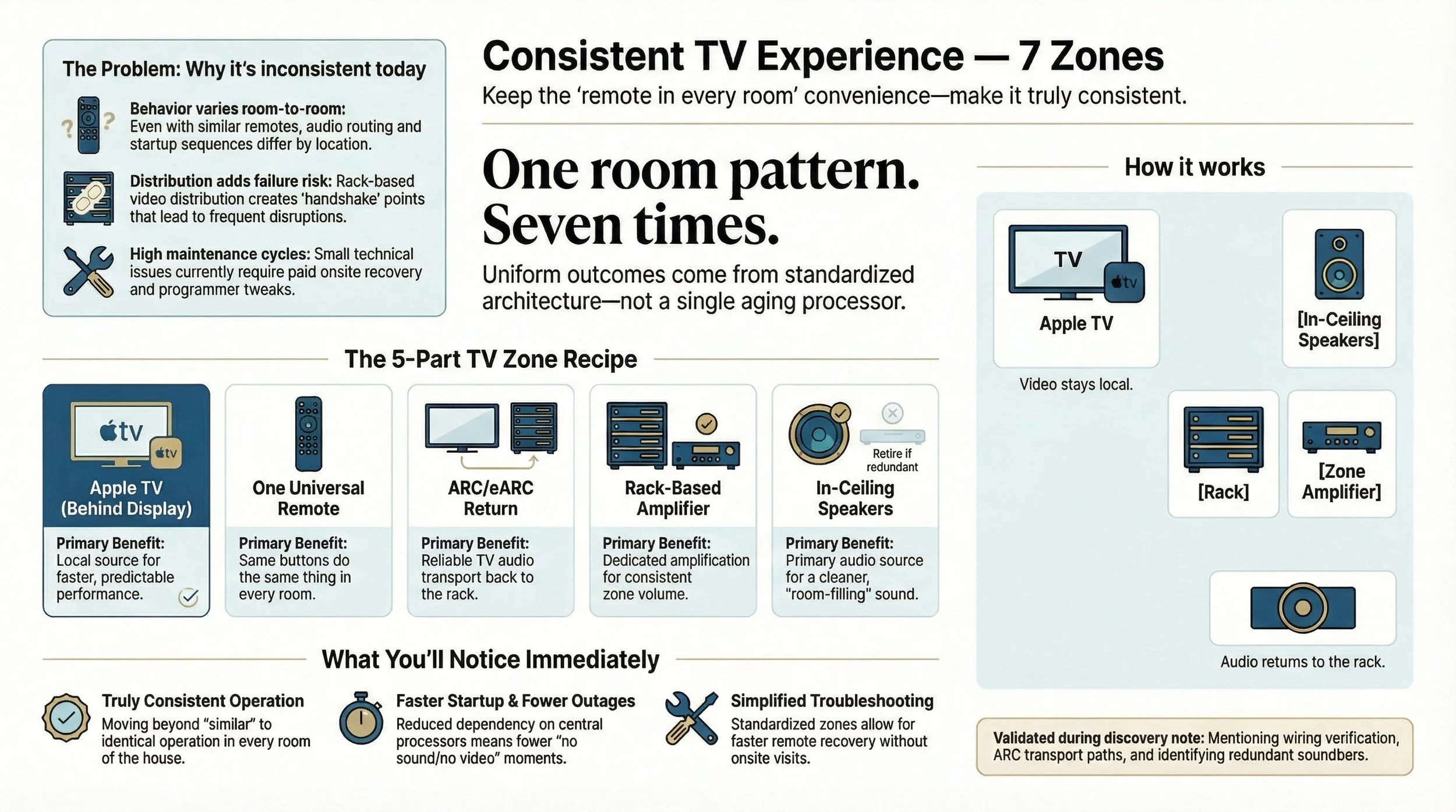
7 standardized TV zones
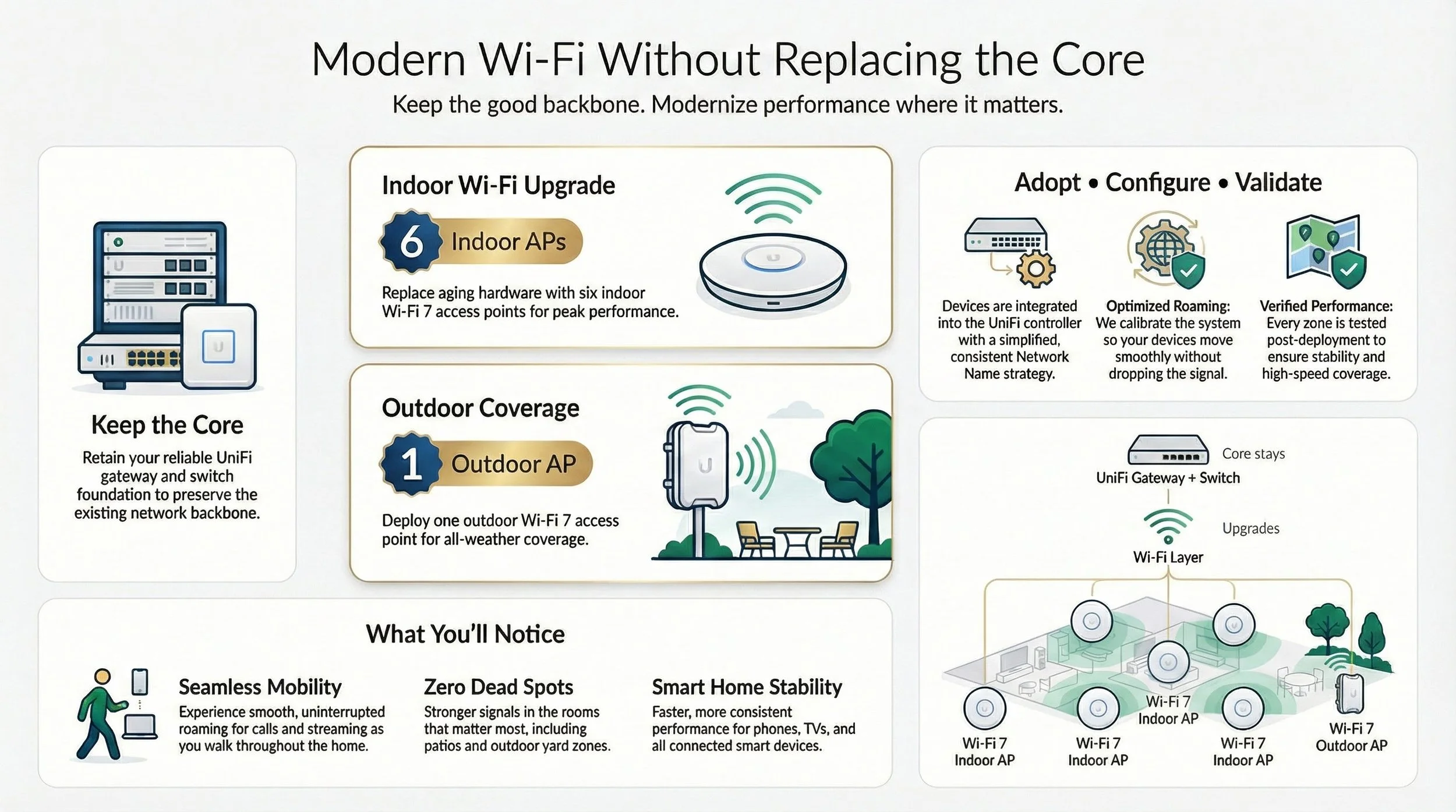
Wi-Fi 7: 6 indoor APs + 1 outdoor AP
Security takeover: Alarm.com + PowerG hardwired zone takeover
Cameras: Reolink → UniFi Protect (NVR + storage + new cameras)
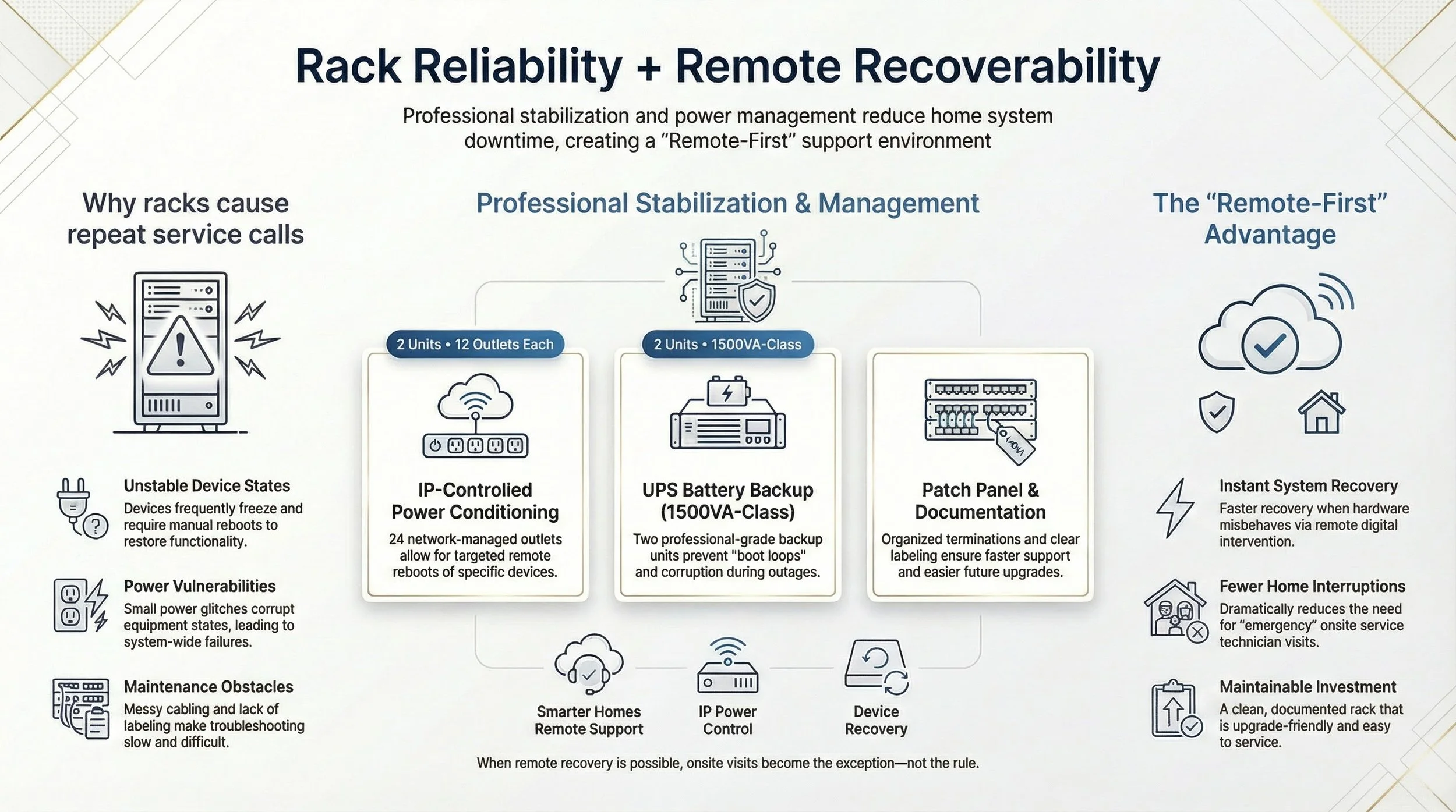
Rack reliability: 2 IP power conditioners + 2 UPS units
Total investment: $82,851.96 (sales tax included)
The Situation
The homeowner had Crestron remotes in every room, but the system was built on an aging processor and centralized rack-based video distribution. As the processor and programming aged, reliability declined and support shifted into a pattern of frequent onsite visits and escalating service costs—without solving the root cause.
“We didn’t need another reboot-and-bill cycle. We needed a system that could be supported without constant onsite visits.”
The Challenge
Crestron-era architecture often creates two long-term problems:
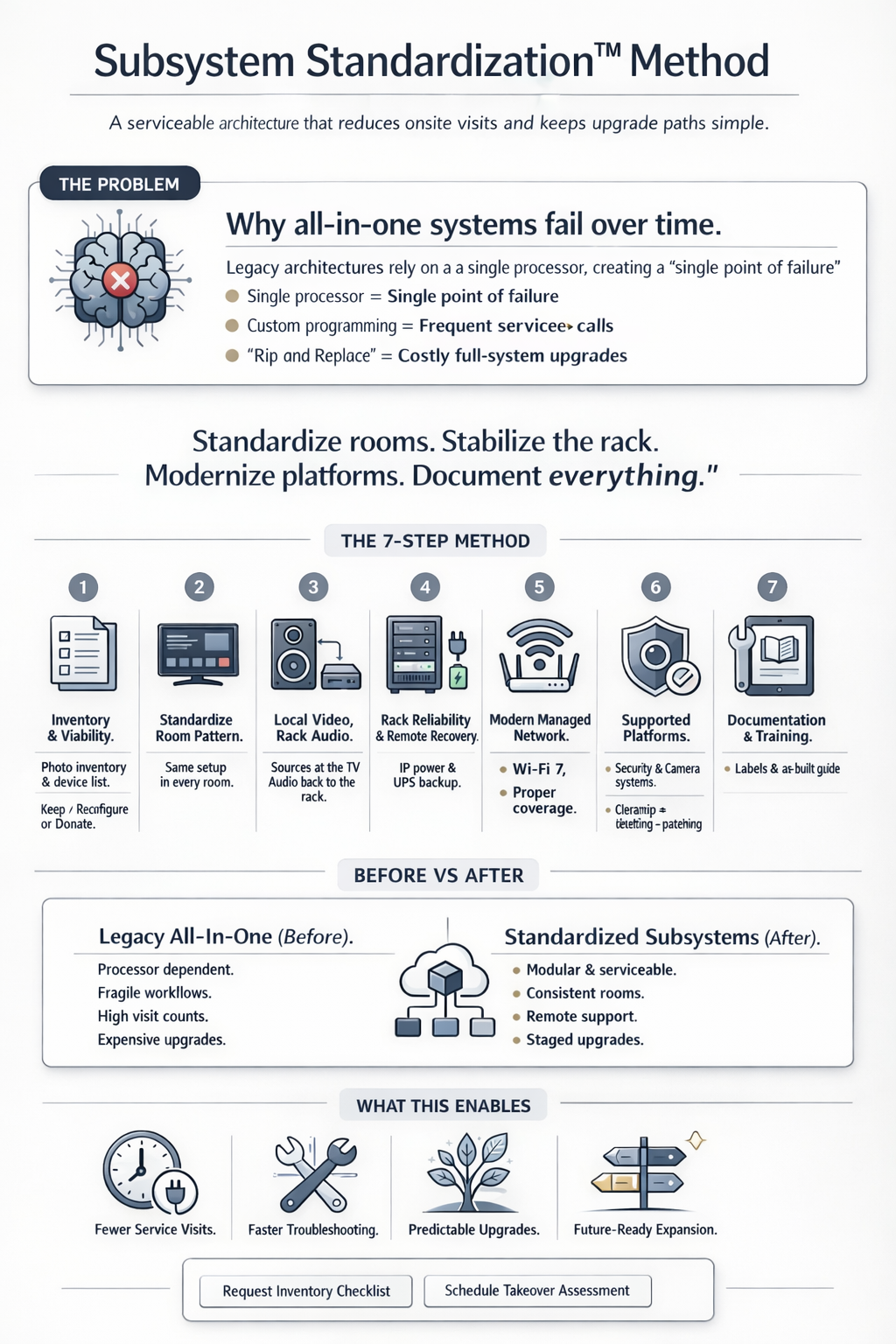
Single point of failure: an all-in-one processor becomes the “health” of the entire home
Fragile distribution: sending high-bandwidth video throughout a home increases handshake issues and troubleshooting complexity
On top of that, the homeowner had room-by-room inconsistencies (example: a room with both a soundbar and in-ceiling speakers wasn’t using the in-ceiling speakers the way it should for everyday TV).
The Smarter Homes Approach
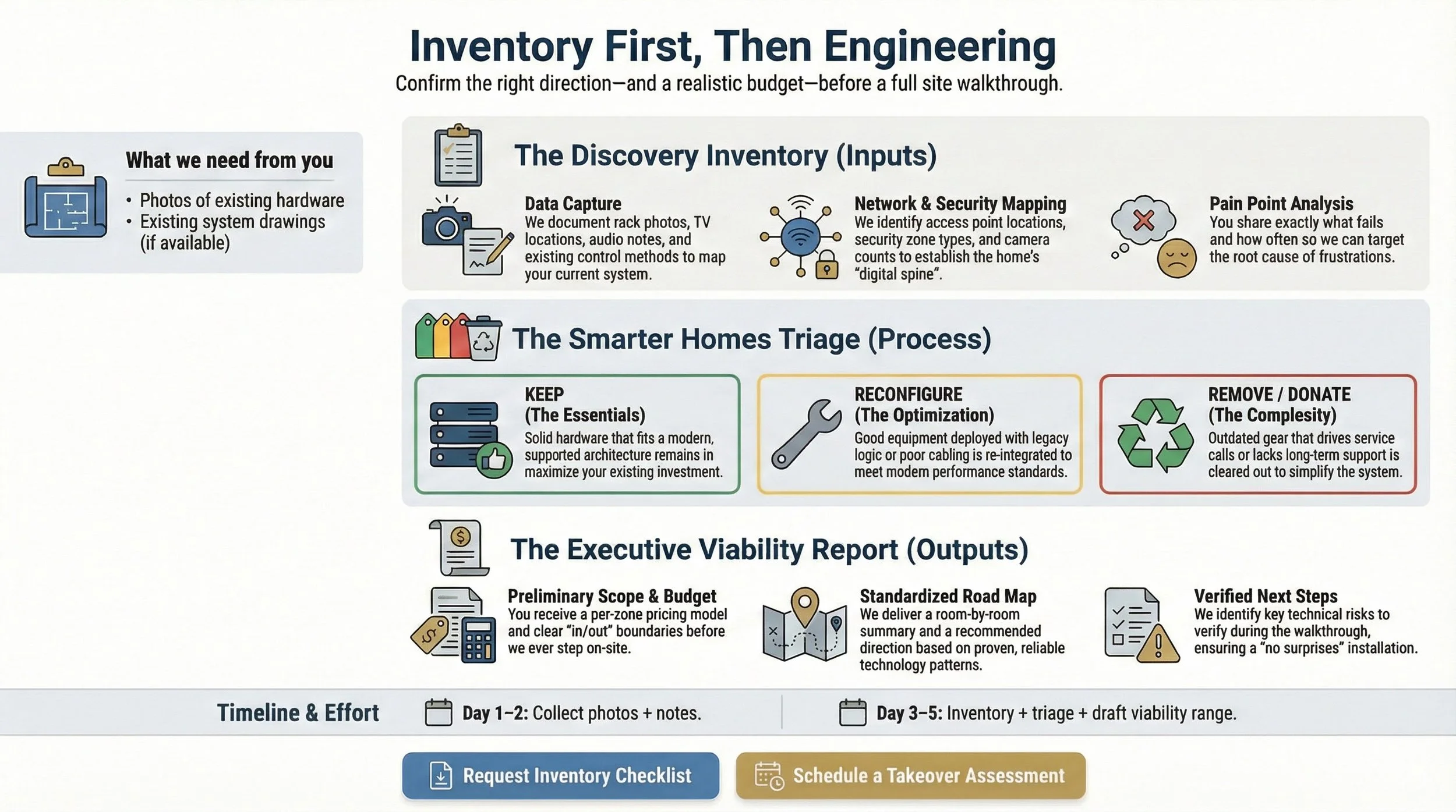
1) Inventory first, then engineering
Before committing to a full walkthrough, we built an inventory to determine what should stay, what should be reconfigured, and what should be removed/donated—so the homeowner could confirm viability before deep design.
2) Replace “all-in-one control” with standardized subsystems
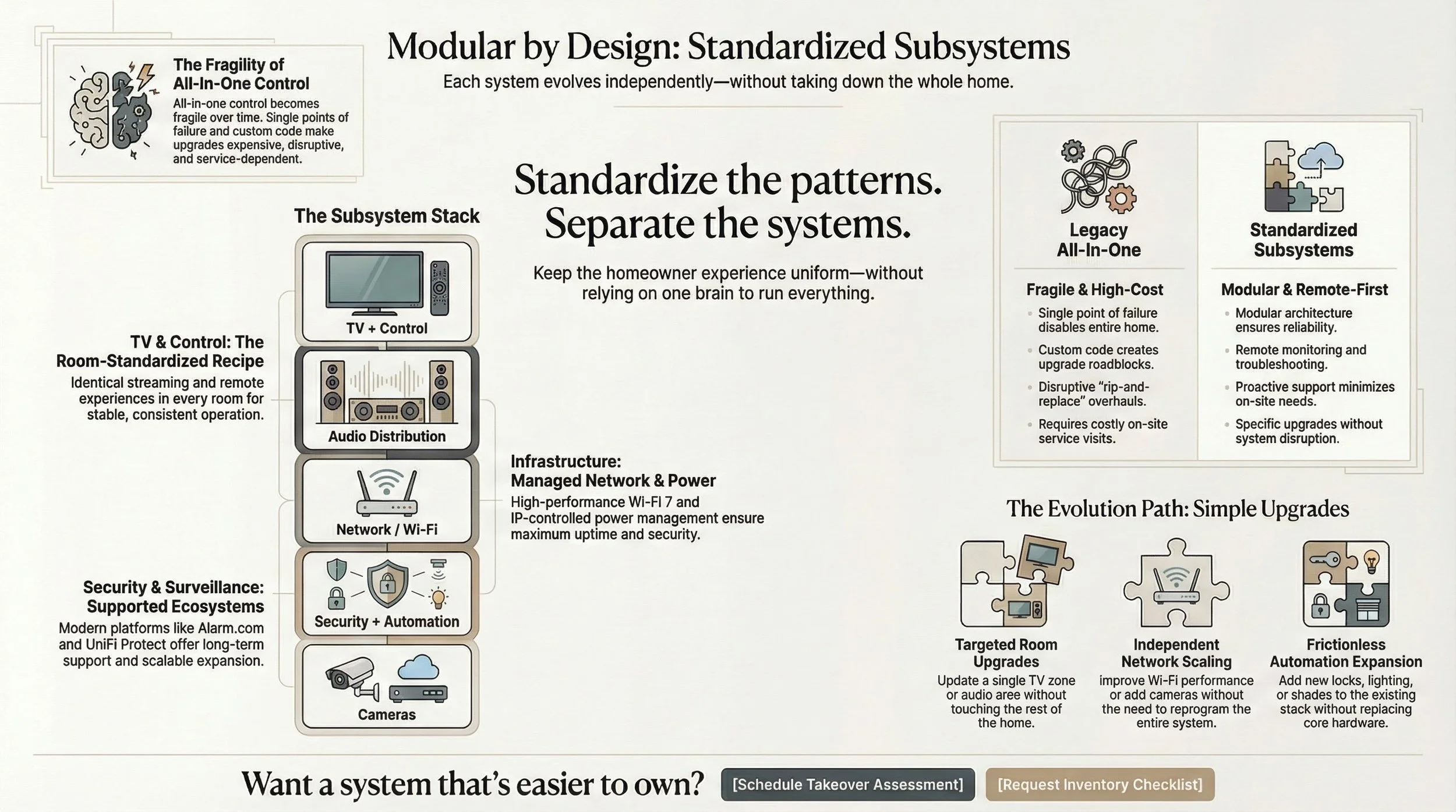
Instead of rebuilding another processor-dependent ecosystem, we designed a platform where each subsystem can evolve independently:
TV + control (room-standardized)
Audio distribution (rack-based, consistent)
Network/Wi-Fi (managed, modern)
Security + automation (modern platform, expandable)
Cameras (supported ecosystem)
“Uniform doesn’t have to mean ‘one brain controls everything.’ Uniform can be achieved with standardized subsystems that are easier to support and cheaper to upgrade.”
The Solution
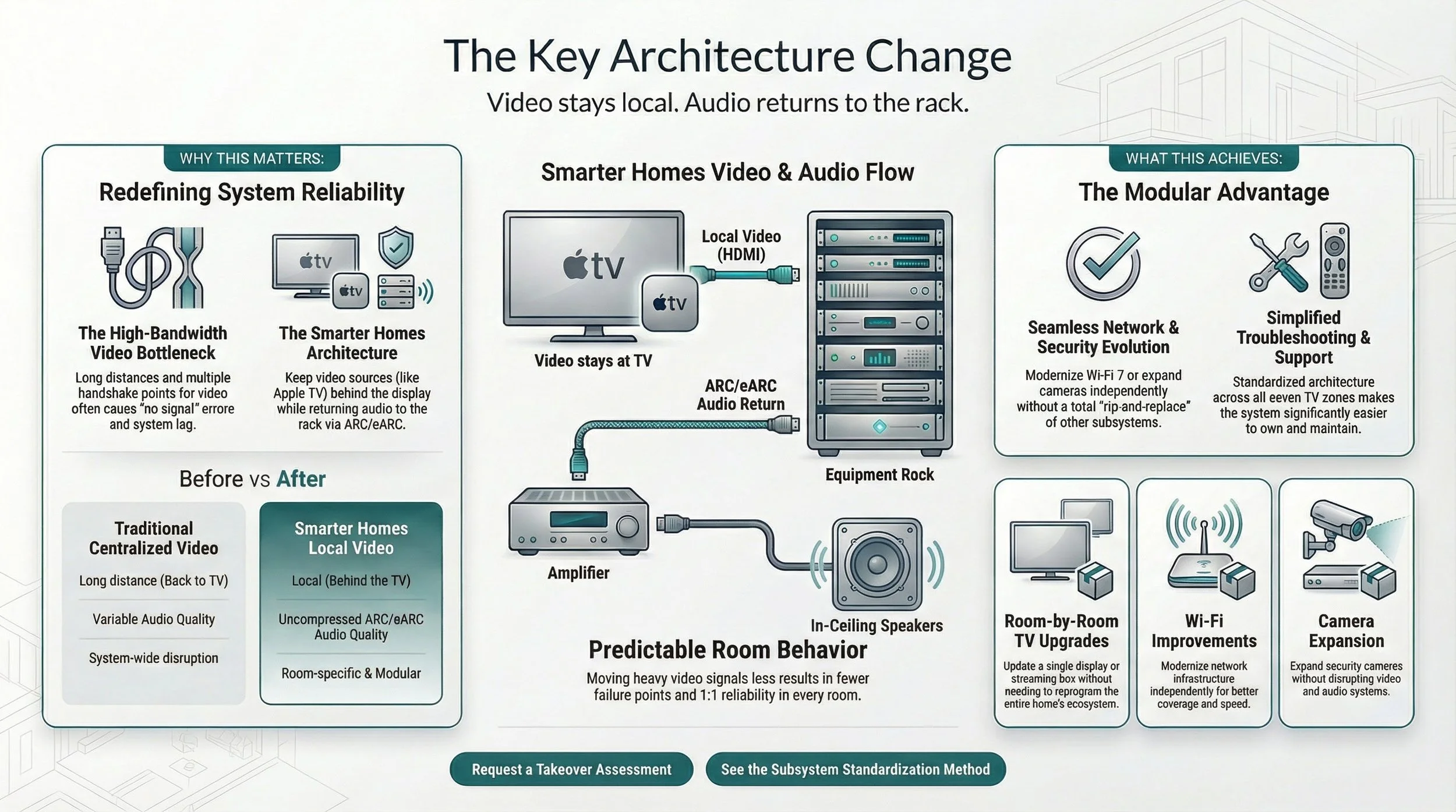
A) Consistent TV Experience Across 7 Zones
Goal: same simple operation at every TV.
Apple TV mounted behind each display (client-supplied)
One simple universal remote per room (no “mode switching”)
ARC/eARC audio returned to the rack over a verified transport path
One rack amplifier per TV zone driving in-ceiling speakers
Where soundbars exist alongside in-ceiling speakers, the intent is to transition TV listening to the in-ceiling speakers for consistency (confirmed during discovery)
Pricing structure: standardized TV zone package applied per location.
B) Rack Reliability + Remote Recoverability
Goal: reduce downtime and avoid unnecessary onsite visits.
Two IP-controlled power conditioners (12 individually controlled outlets each)
Two 1500VA-class UPS units
Patch panel + cleanup + labeling + documentation
C) Modern Wi-Fi Without Replacing the Core
Goal: keep the good backbone, modernize performance.
Retain client-supplied UniFi gateway/switch
Replace indoor access points with six Wi-Fi 7 APs
Add one outdoor Wi-Fi 7 AP
Adopt/configure, validate roaming, confirm SSID strategy
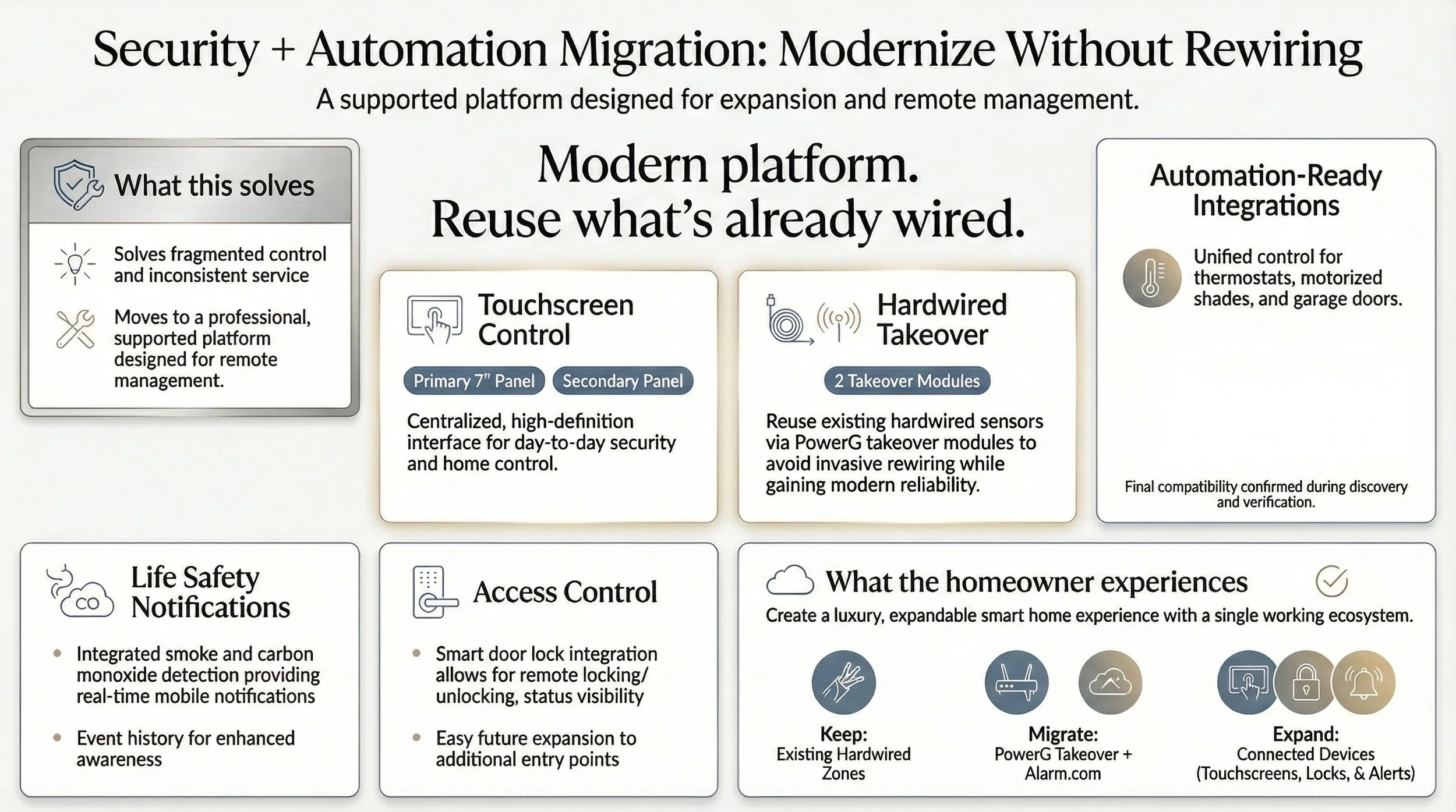
D) Security + Automation Migration (Alarm.com + PowerG Takeover)
Goal: a supported platform designed for expansion and remote management.
Primary Qolsys 7” touchscreen + secondary touchscreen
Two PowerG wired-to-wireless takeover modules (reuse existing hardwired zones)
Alarm.com integration placeholders (validated during discovery): thermostats, shades, garage control
Fire/CO self-monitored notifications (smoke + CO)
Door lock integration
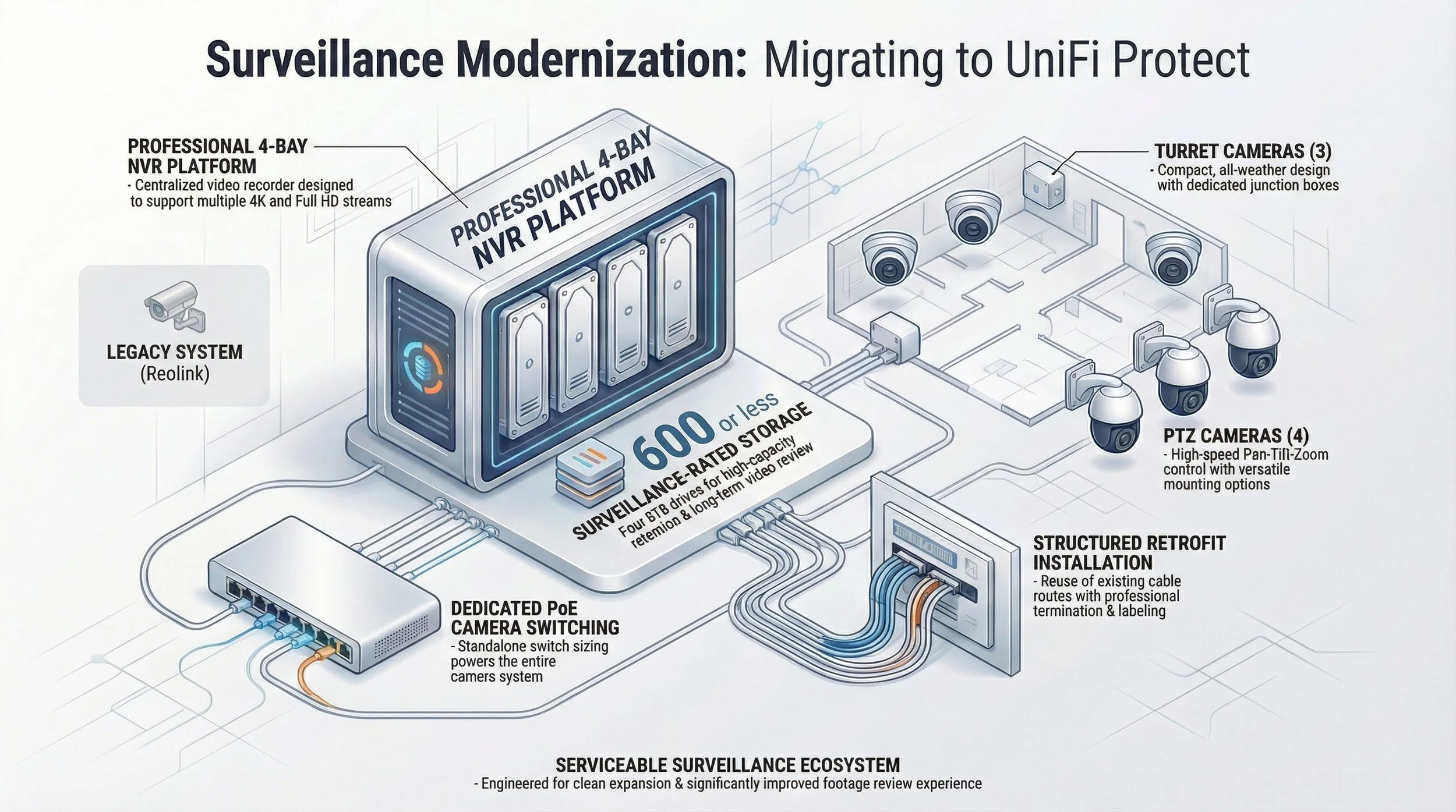
E) Supported Cameras: Reolink → UniFi Protect
Goal: a serviceable surveillance ecosystem with clean expansion.
4-bay NVR + storage drives
Turret + PTZ cameras
Dedicated PoE switching sized for the camera system
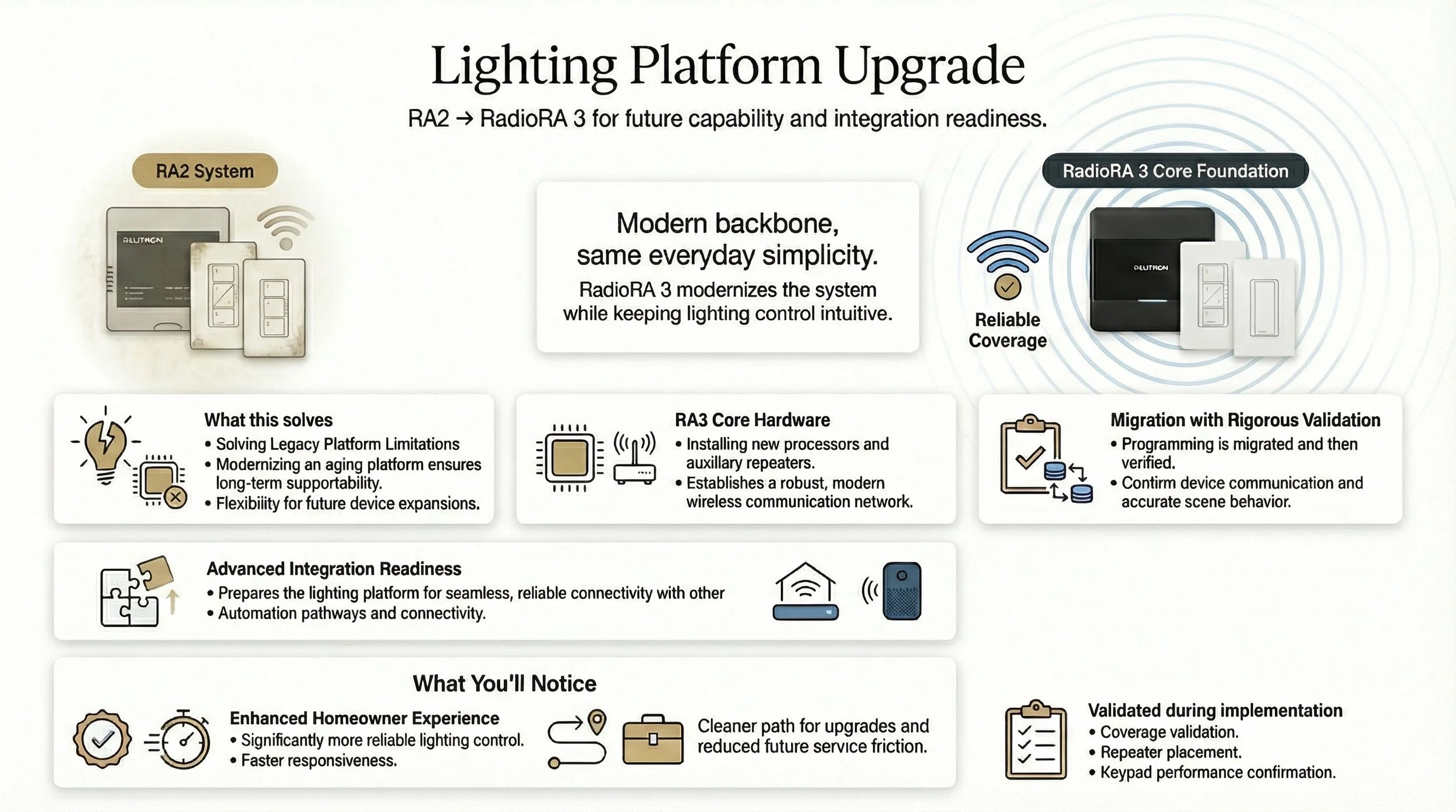
F) Lighting Platform Upgrade:
RA2 → RadioRA 3
Goal: modernize the lighting platform for future capability and integration readiness.
RA3 processor + auxiliary repeaters
Migration, validation, and integration readiness checks
Why This Works
The key architecture change
Video stayed local. Audio returned to the rack.
Video is the highest bandwidth, most failure-prone part of multi-room distribution. By moving sources closer to each TV and sending audio back via ARC return for centralized amplification, we reduced failure points and standardized operation across rooms.
The “upgrade path” benefit
Subsystems can be upgraded independently over time:
New TV or new streaming box? Update one room—no system-wide reprogram
Need better Wi-Fi? Replace APs—no rip/replace of security/cameras
Want more cameras? Add to Protect—no platform rebuild
Commercial Snapshot
Total: $83k (tax included)
Terms: 80% at signing / 20% at completion
Optional recurring services shown separately (monitoring/support).
The Takeaway
If your home is trapped in a legacy control ecosystem with frequent service visits, the answer isn’t “another processor upgrade.” The answer is a serviceable architecture: standardized subsystems, clean documentation, and a support model designed around remote resolution first.
Ready to escape the high-visit-count cycle?
Schedule a Takeover Assessment
Request a Pre-Walkthrough Inventory Checklist
Explore: “Why Subsystems Beat All-In-One Control”
