What Is an HTA Certification? And Why Should You Care?

HTA Certified logo with a green checkmark (Home Technology Association certification).
If you’ve ever felt overwhelmed by the world of smart homes wondering which company actually knows what they’re doing versus who just watched a YouTube tutorial you’re not alone. That’s exactly why the Home Technology Association (HTA) exists. Think of HTA Certification as the Michelin star of the home technology world. Except instead of five-star dining, you’re getting five star Wi-Fi, motorized shades, home theaters, and automation that won’t leave you rebooting at 2 a.m.
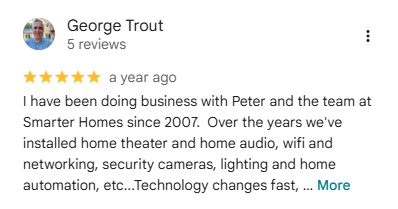
5-star Google review screenshot praising Smarter Homes’ home automation, lighting, and AV work.
So, what is HTA Certification? Simply put, it’s a rigorous standard that only the best home technology integration firms in the U.S. and Canada can achieve. The HTA gathered input from more than two dozen industry experts to create criteria that separate the pros from the pretenders. For homeowners, architects, and designers, it’s a badge of quality a way to know you’re hiring a company that won’t ghost you mid-project or leave wires dangling like spaghetti.
How Do Companies Earn HTA Certification?
It’s not just about having a slick logo or fancy website. Companies must prove themselves in three main areas:
Business performance – No shady lawsuits, tax liens, or “we’ll totally call you back next year” reputations.
Technical competence – They’ve got to deliver professional-grade networks, flawless installs, and reliable aftercare service (because let’s face it, even the best smart homes need a little TLC).
Operational standards – Background checks for employees, proper insurance, and even a promise to hand over the system programming code to the client. Translation: no hostage situations with your smart home.
And they need endorsements, too. Think of it like getting letters of recommendation, except instead of your old high school teacher, it’s top manufacturers, design professionals, and industry peers vouching for them.
The Three Tiers of HTA Certification
HTA knows not all homes or budgets are created equal, so they’ve created three certification tiers:
Foundation – For smaller homes under 5,000 square feet. Budgets are usually under $50K, projects last days or weeks, and the focus is solid customer service. Translation: dependable tech without going full Tony Stark.
Luxury – For larger, design driven homes where technology is just as important as the Italian marble countertops. Budgets range from $50K to $250K, with projects lasting weeks to months. Expect polished engineering documentation and high-end automation.
Estate – The crème de la crème. We’re talking sprawling residences over 10,000 square feet, multiple structures, domestic staff, and a technology budget often well over $250K. These projects take months or years and require concierge-level service. Basically, if your Wi-Fi needs to stretch from the wine cellar to the helipad, this is your tier.
Why Does HTA Certification Matter?
Because smart homes aren’t just about gadgets they’re about trust, performance, and long term peace of mind. HTA Certification gives you confidence that your integrator won’t just install your system but will stand behind it. No gimmicks, no shortcuts just verified professionals committed to excellence.

Plus, the HTA has created partner programs for architects, designers, and builders to make sure everyone plays nicely together. That means fewer “oops” moments on the job site and more homes where design and technology actually work in harmony.
Where Smarter Homes of Austin Fits In
Smarter Homes of Austin is proud to carry the HTA Certified badge. As one of the few firms in the region to achieve this certification, they’ve proven not just their technical skills but also their commitment to customer experience. For homeowners, that means you’re not just hiring a contractor you’re gaining a trusted partner who understands the intersection of technology, design, and lifestyle.
Smarter Homes of Austin regularly works with architects, builders, and designers who rely on them to bring complex smart home visions to life. From Lutron lighting and shades to UniFi networking and high performance home theaters, the team delivers solutions that make luxury living effortless. They’re HTA Certified, clients have the reassurance that every project, whether it’s a modern downtown condo or a Hill Country estate, meets the highest standards.
Let’s be honest: technology can be frustrating. One wrong cable and suddenly your “smart” home feels more like an expensive Rubik’s Cube. That’s where Smarter Homes of Austin shines. Their certification means they’ve already been tested for competence, reliability, and service. In other words, they’ve done the homework so you don’t have to and that makes all the difference.

Modern, light-filled living room with large windows, gray sectional and two matching chairs around a round black coffee table;
Built-in wood-and-stone cabinetry with two wall-mounted TVs and a sleek linear niche, all in a calm neutral palette.
The Bottom Line
Hiring an HTA Certified firm is like hiring a pilot with a license instead of someone who “flies for fun on weekends.” It’s your assurance that the company bringing tech into your home has been vetted, tested, and proven worthy of the badge.
So next time someone says they can “make your home smart,” ask them: Are you HTA Certified? If the answer is yes, congratulations you’ve found the real deal. If the answer is no, well… you might want to keep shopping.
Download PDF Content on HTA Certification.
Frequently Asked Questions about HTA Certification
-
The Home Technology Association (HTA) is a non-biased third-party organization that has established the first and only standard of excellence for home technology companies. Launched in 2017, its mission is to improve integrators’ reputation with architects, designers, and builders. The HTA aims to take the guesswork out of deciding which companies are trustworthy, technically qualified, and have a proven history of excellent client care.
-
An HTA Certified Integrator is a firm that has undergone a rigorous background check to ensure they are technically competent, demonstrate solid customer service, and have a positive reputation. Less than 10% of companies achieve this status. These firms are a group of like-minded companies committed to providing best-in-class design, installation, and service, with a dedication to continual improvement.
-
When you choose an HTA Certified Integrator, you can rest easy knowing that you will love the new technology in your home. The HTA's stringent, nationwide standards ensure that the company you hire is trustworthy, technically qualified, and has a proven track record of client satisfaction. This certification eliminates the guesswork from selecting an installation firm, which will have a significant impact on how you live in your home. Public figures like James Harris from the TV series "Million Dollar Listing" emphasize the essential nature of hiring an HTA Certified Home Technology Professional.
-
You can expect several key attributes from an HTA Certified Company, including:
• Seasoned professionals with proven technical expertise.
• Phenomenal, ongoing aftercare service.
• Endorsements from manufacturers, local industry peers, and design/build professionals.
• Background checks for all new employees.
• Proven, strong business performance.
• The ability to deliver high-performance enterprise-grade computer networks.
• A reputation you can trust.
-
The HTA Code of Conduct outlines the ethical and professional standards that HTA Certified firms are expected to uphold. This code emphasizes:
• Community: Encouraging certified dealers to network, build friendships, help each other, and avoid disparaging competitors. Instead, firms should focus on their unique selling proposition and use their HTA Certification to differentiate themselves. Mentoring other integrators by offering constructive feedback is also encouraged.
• Customer Service / Aftercare: Stressing the vital importance of client care after the sale for long-term success and customer loyalty. The HTA recommends (though does not require for certification) using a ticketing system for service requests and educates clients that 24-hour service often involves recurring subscription fees.
• Professionalism: Requiring vital product training for technicians and strongly recommending the creation and charging for design and engineering documentation, even though it's not required for the Foundation tier of HTA Certification. Firms are also expected to be diligent in finishing the last 5% of a project.
• Profitability: Recognizing that HTA Certified dealers have a strong competitive advantage and deserve to earn a fair profit. HTA discourages competing on price, advocating that firms compete on competence. It also suggests using the HTA technology budget calculator and educational articles to help clients understand realistic financial parameters and the value of services. Failure to adhere to these points may lead to exclusion from or loss of HTA Certification status.
-
The HTA Certification was created due to significant challenges in the home technology integration industry. Many installers are described as "hobbyists" who love technology but struggle with implementation and, critically, customer service. Poor customer service has harmed the industry's reputation, especially with architects, builders, and designers, who have been "burned" by integrators who oversell capabilities or fail to provide adequate client care. HTA was formed to weed out reputable integrators from the rest and provide design/build professionals with a trustworthy option for hiring.
-
The HTA certification process is rigorous and can take weeks to complete. Companies are scored on various criteria, including their technological abilities, attention to customer care, and overall reputation within the industry.
