The Heart Of How The Home Technology Industry Is Structured.
The Purchasing Process
As a homeowner, builder, or even an electrician, you usually can’t just walk into a distributor like Bell & McCoy and buy Lutron, Control4, Savant, or other pro grade systems off the shelf. These companies are authorized distributors who only sell directly to certified integrators. That’s because the technology isn’t plug and play, it requires programming, networking, and design expertise to function properly.
For example, if you wanted a Lutron HomeWorks system or Ketra lighting, Bell & McCoy would supply those products, but only to an authorized integrator who has the training, software licenses, and support access. Manufacturers and distributors do this to protect both the quality of the install and the end user experience.
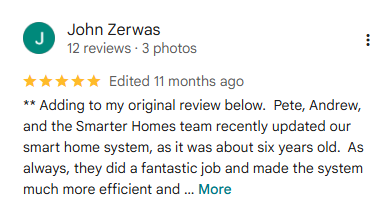
5-star Google review: praise for Pete’s team handling AV, Wi-Fi, TVs, smart lighting, and security cameras.
Why Consumers Can’t Buy Direct
It might feel restrictive, but there’s a reason: these systems are complex. Unlike a DIY device from Best Buy, they need proper engineering, installation, and ongoing service. If anyone could just buy the gear, you’d end up with frustrated homeowners, miswired systems, and expensive mistakes. Integrators bridge that gap by being trained, insured, and accountable.
How Builders and Electricians Fit In
Builders and electricians often partner with integrators. A builder may rough-in wiring or coordinate schedules, but the integrator designs and commissions the system. Electricians may run conduit or power lines, but they don’t typically program shades, lighting processors, or automation software. That’s why forming a relationship with a trusted integrator early is critical, it ensures your project is designed right from the beginning.
Bottom Line
Homeowners: Work through an HTA-certified integrator (like Smarter Homes of Austin) who sources from distributors.
Builders: Partner with integrators to handle design, programming, and support.
Electricians: Handle power, while integrators handle low-voltage and programming.
Designers
Distributors like Bell & McCoy: Supply only to authorized, certified integrators.
So, no, you can’t just buy directly unless you have that integrator connection. But by working with an integrator, you gain not just access to products, but the expertise to ensure everything works seamlessly.
“I highly recommend Smarter Homes for any of your home automation, AV, and lighting needs. They have consistently provided us with excellent equipment and professional service for many years. Just this week we changed internet providers and Smarter Homes had Andrew come over to make certain that the new provider did not mess up any part of our existing system. Then, after the new provider technician left, Andrew created a bridge from the new modem to our router and access points so everything worked smoothly.”
The Home Technology Purchasing Process: What Homeowners, Builders, and Electricians Need to Know
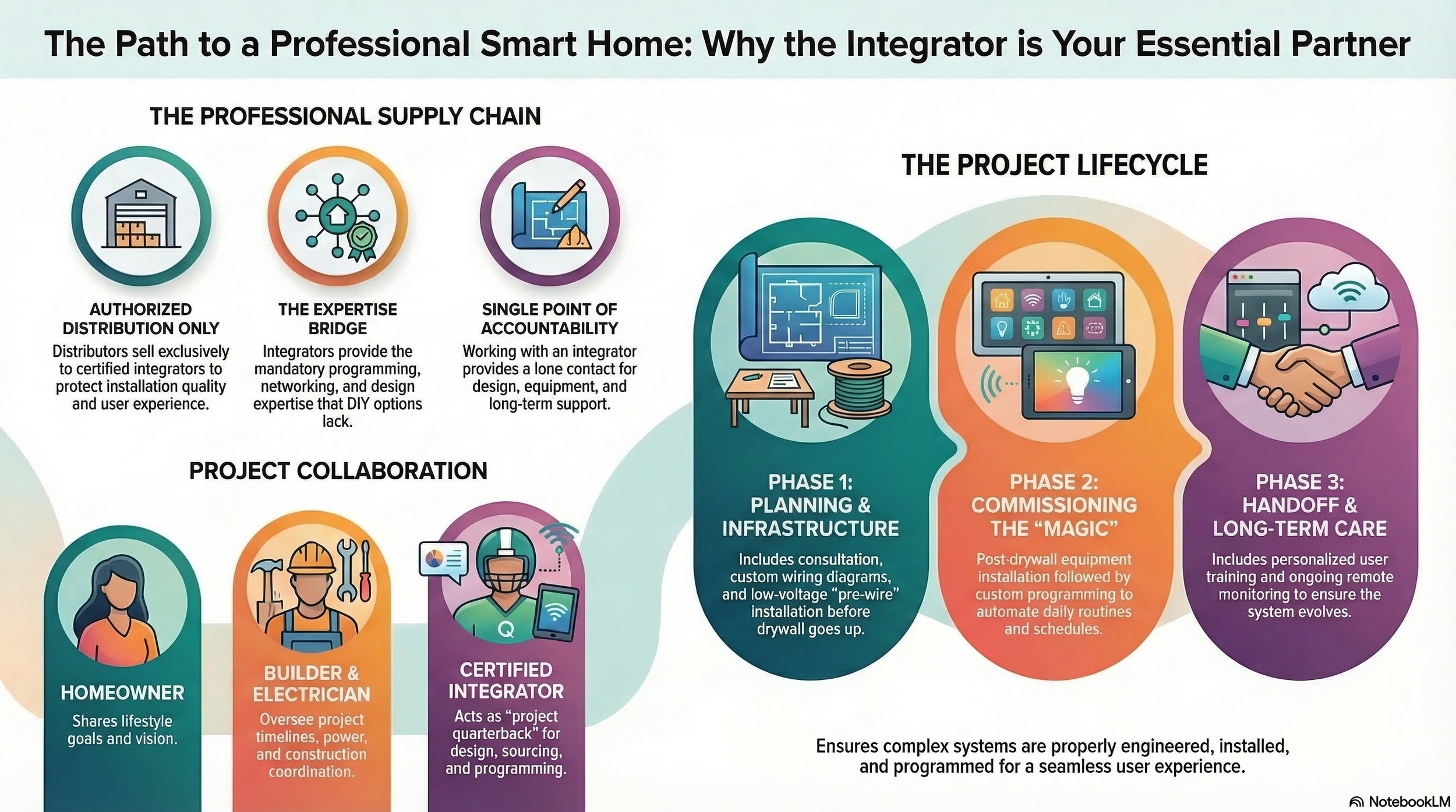
If you’ve ever wondered how to bring smart home technology into your project, you’ve probably also wondered: Can I just buy products directly from places like Bell & McCoy? The short answer: no. Distributors only sell to authorized, certified integrators who have the training, licensing, and expertise to design, install, and program these systems.
That’s where Smarter Homes of Austin comes in. As an HTA-certified integrator, they guide you through the entire process, from dream to design to reality, ensuring your home technology works flawlessly and looks beautiful.
Step 1: Initial Consultation
Your journey begins with a conversation. Smarter Homes of Austin meets with you to understand your vision: Do you want motorized Lutron shades, whole home automation, a world class home theater, or simply a reliable Wi-Fi network that won’t let you down?
Homeowners share their lifestyle goals.
Builders bring in blueprints and project timelines.
Electricians often join to align on wiring needs.
Designers
Smarter Homes listens, asks the right questions, and sets the foundation for a system that fits your life, not just a box of gadgets.
Step 2: Custom Design & Proposal
Once your goals are clear, Smarter Homes of Austin creates a custom technology design plan. This includes wiring diagrams, system layouts, and a line by line proposal so you can see exactly what you’re getting.
Builders and electricians also receive these documents to coordinate their part of the project, ensuring smooth collaboration.
Step 3: Purchasing Through Authorized Channels
This is where distributors like Bell & McCoy come in, but here’s the key: they only sell to integrators. As the client, you don’t buy directly. Instead, Smarter Homes of Austin sources all products from these distributors, ensuring you get manufacturer warranties, certified gear, and no risk of incompatible parts.
Step 4: Pre-Wire & Infrastructure
Before drywall goes up, Smarter Homes of Austin installs all low-voltage wiring for shades, speakers, cameras, and networks. At the same time, electricians run electrical power. Builders oversee coordination so everything comes together without delays or surprises.
Step 5: Equipment Installation
Once the home is ready, Smarter Homes installs the gear: lighting keypads, Lutron shades, speakers, racks, networking equipment, and more. Everything is mounted with design in mind, clean, seamless, and luxury-level.
Step 6: Programming & Commissioning
Here’s where the “smart” in smart home comes alive. Smarter Homes programs your system to fit your routines. Want the shades to lower at sunset and the lights to shift to a warm glow? Done. Want music throughout your home that you can control from your phone? Easy.
This programming expertise is why HTA-certified integrators matter, without it, you just have expensive electronics without the magic.
Step 7: Training & Handoff
Smarter Homes doesn’t just walk away once the system is installed. They sit down with you to train you on how everything works. You’ll learn how to use the apps, wall controls, and automation features so your home feels effortless from day one.
Step 8: Ongoing Service & Support
Technology isn’t one and done, it evolves. Smarter Homes of Austin provides long-term support, remote monitoring, and proactive updates. When you need help, you call one trusted partner, not a dozen different manufacturers.
✅ The Bottom Line
Distributors like Bell & McCoy supply the products, but only to certified integrators.
Smarter Homes of Austin is your access point, not just to the products, but to the expertise that makes them work.
Designers, Builders, electricians, and homeowners all benefit from having Smarter Homes as the “project quarterback” who ensures technology, design, and lifestyle all line up seamlessly.
-
0:04
Welcome to this custom deep dive today. We're on a mission to decode something you've probably run into if you are building or remodeling the luxury home technology purchasing process. Yeah, and why getting pro grade systems is, well, it's a completely different universe from buying a DIY smart gadget off the shelf, right? Think of it like this. Imagine buying elite engine parts, you know, just dumping them on your driveway and expecting a high performance sports car to start up. You can't. You need a master mechanic to actually make it run exactly. And that's exactly the case with systems like Lutron homeworks or ketra control four savant, it's a whole different level of engineering. Well, let's unpack this a bit, because to understand why you can't just buy direct we have to look at the expertise required, like, why can't I just buy this gear from a distributor like Bell and McCoy? So a lot of people hit a wall there. Distributors exclusively sell to authorized HTA certified integrators. Oh, wait, really, they won't sell to the homeowner, no. And that restriction is totally on purpose. It protects the installation quality, the warranties, and obviously the user experience. This pro grade tech simply isn't plug and play. Okay? So if the integrator handles the technology, how exactly do the builders or the designers and electricians fit into the process. I mean, electricians are already wiring the house, so why not let them install the smart systems? That is a super common misconception, actually, and honestly, it leads to some wildly expensive mistakes. Oh, I bet, yeah. So think of an electrician as building the muscles of the house. They handle the high voltage power lines, but the integrator they design the central nervous system. They manage the complex low voltage wiring and the networks. Okay? So the integrator acts as the like the project quarterback, exactly. They coordinate with the builders and designers, so you don't get, you know, interference or incompatible parts if an untrained crew crosses those wires, literally or figuratively, the system simply cannot talk to each other. So how does this quarterback actually execute the play? It sounds like early planning is pretty critical here. Oh, completely. It's really an eight step journey. First you have the initial consultation, followed by a custom design and proposal, then purchasing through authorized channels, right? And then step four is the pre wire, which is super crucial. Yes, you have to do the pre wire before the drywall goes up. Yeah, especially for lighting, shades, audio, security cameras, you know, networking once the walls are closed, running new cable is an absolute nightmare I can only imagine. So after pre wire comes the equipment installation.
2:40But here is where it gets really interesting to me. Step six, programming and commissioning. Yes, without custom programming, the home isn't really smart, it's just a collection of expensive electronics. Right spot on programming is the magic. It's what makes the shades automatically lower at sunset or the lights shift to a warm glow. You aren't opening five different apps. Everything just works together, which leads right into step seven, client training and then step eight, ongoing support. But I want to push back on that last part of it, because things inevitably change. Are homeowners stuck navigating a bunch of one 800 customer service lines when say, the internet goes down. Well, that's why working with one trusted integrator like Smarter Homes of Austin is so important they provide proactive, long term support, okay, so give me an example of how that actually works in practice. Yeah. So there's a great example where a client recently changed their internet provider. Normally, plugging in a new ISP modem would completely wreck a complex luxury network. Oh, yeah, my DIY stuff at home breaks whenever the router resets, right? But instead of the homeowner dealing with an ISP technician who doesn't understand the system, Smarter Homes sent their own technician, Andrew out to the house. Oh, no, yeah, he actively bridged the new modem to the home's existing router and access points, so the entire automation system just kept running smoothly. No confusion, no miscommunication. That is huge. So homeowners don't just need access to products. You really require expertise, coordination and that support Exactly. Professional technology works best when it's planned, early, sourced, correctly installed, properly programmed, intentionally and supported long term by a certified integrator. I love that summary, and it leaves you with this provocative thought to chew on. As our residences evolve into these highly complex, automated ecosystems, will the future of home ownership feel less like traditional property maintenance and more like managing a living breathing it network?
Download PDF Content on Smart Homes Here.
Frequently Asked Questions about How The Home Technology Industry Is Structured.
-
Smart Home Technologies (SHTs) broadly refer to sensors, monitors, interfaces, appliances, and devices that are networked together to enable automation and both localized and remote control of a domestic environment. The term "smart homes" is a generic descriptor for introducing enhanced monitoring and control functionalities into homes. Fundamentally, SHTs integrate technology and services through home networking to improve the quality of living. These technologies allow appliances and devices to be automatically controlled remotely from anywhere with an internet connection, using a mobile or other networked device.
-
SHTs involve a diverse range of components and systems:
• Controllable Devices: These include heating and hot water systems (boilers, radiators), lighting, windows, curtains, garage doors, fridges, TVs, and washing machines.
• Sensors and Monitors: These detect environmental factors such as temperature, light, motion, and humidity.
• Control Interfaces: Functionality is provided by software on computing devices like smartphones, tablets, laptops, and PCs, or through dedicated hardware interfaces like wall-mounted controls.
• Networking: Different SHTs are networked, typically wirelessly, using standardized communication protocols.
• Home Controllers/Gateways: These integrate the residence's various home automation systems, often acting as a data concentrator and providing a Human-Machine Interface (HMI). They can also connect to cloud applications for remote management.
-
The Smart Home Technology value chain involves several distinct types of players:
• Chip/Module Makers: These vendors design semiconductors and modules (chipsets) for appliances and gateways, often providing reference designs to demonstrate data gathering and sharing concepts.
• Device/Appliance Manufacturers: They produce the usable smart home systems for customers, frequently building upon reference designs from chipmakers and integrating user experience, form factor, and casing requirements. Companies like Molex, for example, have a broad portfolio including antennas, sensors, flex assemblies, switches, and interconnects used in various smart home applications.
• Mobile/Telecom Service Providers (TSPs): They are crucial for connecting devices and gateways to the internet via wired (e.g., fiber-to-the-home, broadband) or wireless (e.g., 3G, 4G, 5G) networks, providing high-speed and reliable internet services.
• Cloud Service Providers: These entities enable data access, maintenance, and management remotely by offering shared pools of resources and services like Platform-as-a-Service and Software-as-a-Service.
• Application Providers: They develop the web-based or mobile applications that allow consumers to interact with and control their smart home devices remotely.
• Policymakers: They play a significant role in mitigating perceived risks and supporting market development by establishing design and operating standards, guidelines on data and privacy, and quality control.
-
The smart home market has undergone an evolution, moving through three main phases:
• The Enabled Home: By the end of the 20th century, homes contained many discrete technological products (e.g., refrigerators, programmable thermostats). These products required direct human activation and were not connected or interoperable with each other.
• The Connected Home: This is the current phase, where pervasive sensors, interconnects, and robust cloud technology allow devices and appliances to connect with each other and the cloud. Human actuation is less necessary, with voice commands and programmed actions becoming common. However, interoperability between competing technology ecosystems remains a "work in progress".
• The Proactive Home: This is the anticipated next evolution, leveraging artificial intelligence (AI), machine learning, natural language processing, and visual recognition. The home itself will gain the ability to "sense" and learn, anticipating occupants' needs and making intelligent, proactive decisions (e.g., adjusting temperature, waking occupants earlier based on traffic).
-
The global smart home market is characterized by several trends and features:
• Rapid Growth: The global market for smart appliances is projected for massive growth, from $40 million in 2012 to $26 billion in 2019. Overall, the Internet of Things market, which includes smart homes, is estimated at $1.7 trillion globally.
• Regional Dominance: The United States and Canada constitute the largest market, growing at 31% per year, primarily for home security systems and leak detection. Europe focuses on energy cost reduction and healthcare, while Asia is the fastest-growing market, driven by telecom innovation and energy-saving needs.
• Shifting Perception: Smart homes are increasingly seen as a requirement rather than a luxury, especially due to more affordable smart devices and integration into the IoT ecosystem.
• Key Drivers: The primary drivers for SHT adoption include enhanced energy management, improved security, convenience, leisure and entertainment services, and extended personal independence through healthcare and assisted living.
• Technological Advancement: Trends include décor-friendly gadgets, programmable devices, wireless controls, advanced security systems, automated door locks, smart appliances, solar rooftops, and integration with wearable devices and automobiles.
• Customer Expectations: Consumers desire security, hassle-free and cost-effective systems, convenience, proactive technology, smart energy savings, and safeguarded privacy.
