When Light Evolves With Us: The Engineering Behind Responsive Architectural Lighting
For most of history, architecture has been static while human biology has remained dynamic. Our energy levels, mood, and biological rhythms shift constantly from morning to night, yet the environments we inhabit often remain unchanged. Traditional lighting systems illustrate this mismatch clearly.
Standard LED fixtures produce a fixed spectral output that cannot adapt to the human body's changing needs throughout the day. Even when dimmed, most LEDs rely on AC dimmers that reduce electrical power. The brightness decreases, but the underlying light spectrum remains identical.
Over time, another problem emerges. The physical components inside conventional LEDs gradually degrade. As this happens, color shifting occurs, with bulbs in the same room emitting slightly different tones of light as they age. What once appeared uniform becomes mismatched and visually inconsistent, bridging the gap between human biology and static architectural lighting required engineers to rethink the technology entirely.
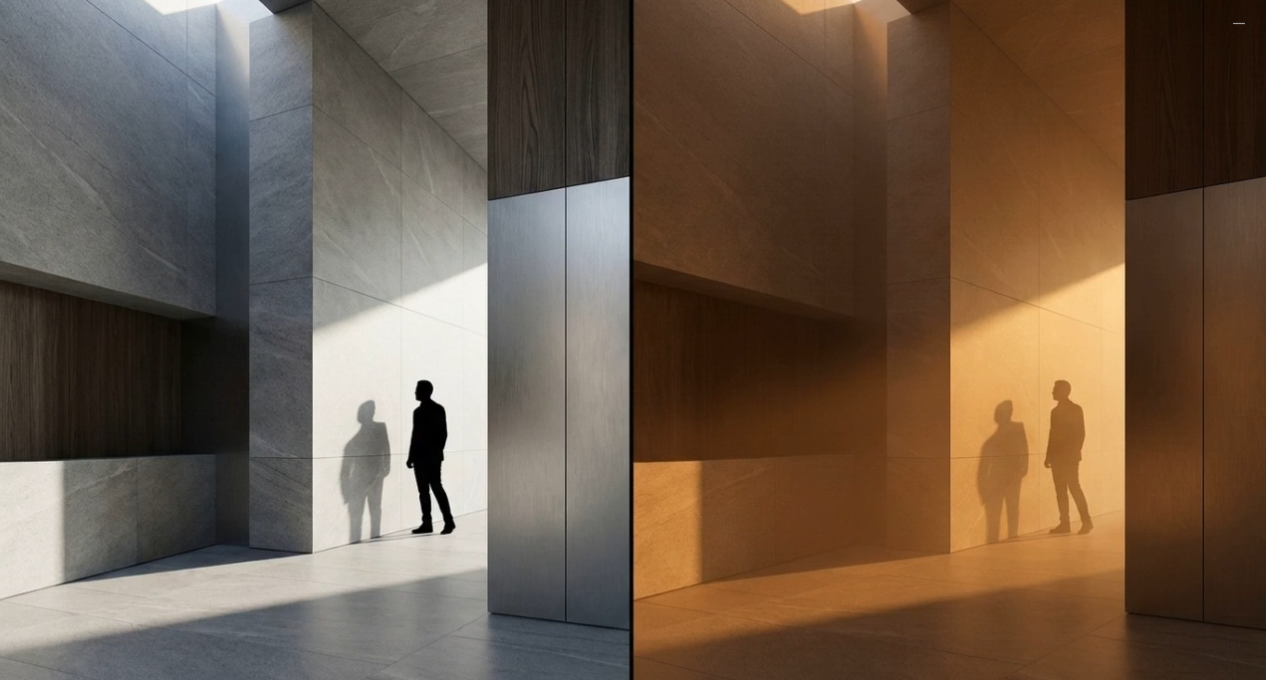
A modern architectural corridor shown under two different lighting conditions. On the left, cool white lighting produces crisp shadows and a neutral, minimal atmosphere. On the right, warm golden lighting fills the same space, creating softer shadows and a more inviting, comfortable mood.
A silhouetted figure standing within both scenes highlights how dramatically lighting color temperature changes the emotional tone and perception of the same environment.
Building a New Lighting Platform From the Ground Up
To solve these challenges, engineers developed an entirely new lighting architecture. Ketra by Lutron was designed with custom power electronics and a proprietary driver chip, allowing each fixture to operate with unprecedented precision and adaptability.
At the core of this system is an internal astronomical clock. This clock calculates a home's exact geographic location and uses that geolocation data to adjust lighting conditions throughout the day continuously. The system automatically adjusts both light intensity and correlated color temperature (CCT) a measure of how warm or cool a light appears.
Rather than relying on manual schedules, the lighting environment responds to the actual sunrise and sunset occurring outside the home. By allowing the rotation of the Earth itself to dictate indoor lighting parameters, the interior environment transitions naturally alongside the outdoor world.
Daylight Precision and Vibrancy
As the day progresses toward midday, lighting requirements change. Natural sunlight becomes brighter and cooler in tone. Ketra fixtures replicate this progression by shifting output toward crisp daylight levels reaching up to 10,000K, creating a clear and energizing environment.
This precision is made possible through a high-definition palette capable of producing up to 16.7 million colors. One of the most powerful tools within this system is Vibrancy Mode, which adjusts the light’s Spectral Power Distribution (SPD). SPD refers to the precise combination of color wavelengths that make up a beam of light. By carefully altering this spectral recipe, the system enhances color saturation and depth in the environment. The remarkable result is that artwork, textiles, and materials appear more vivid and dimensional without altering the room's overall color temperature.
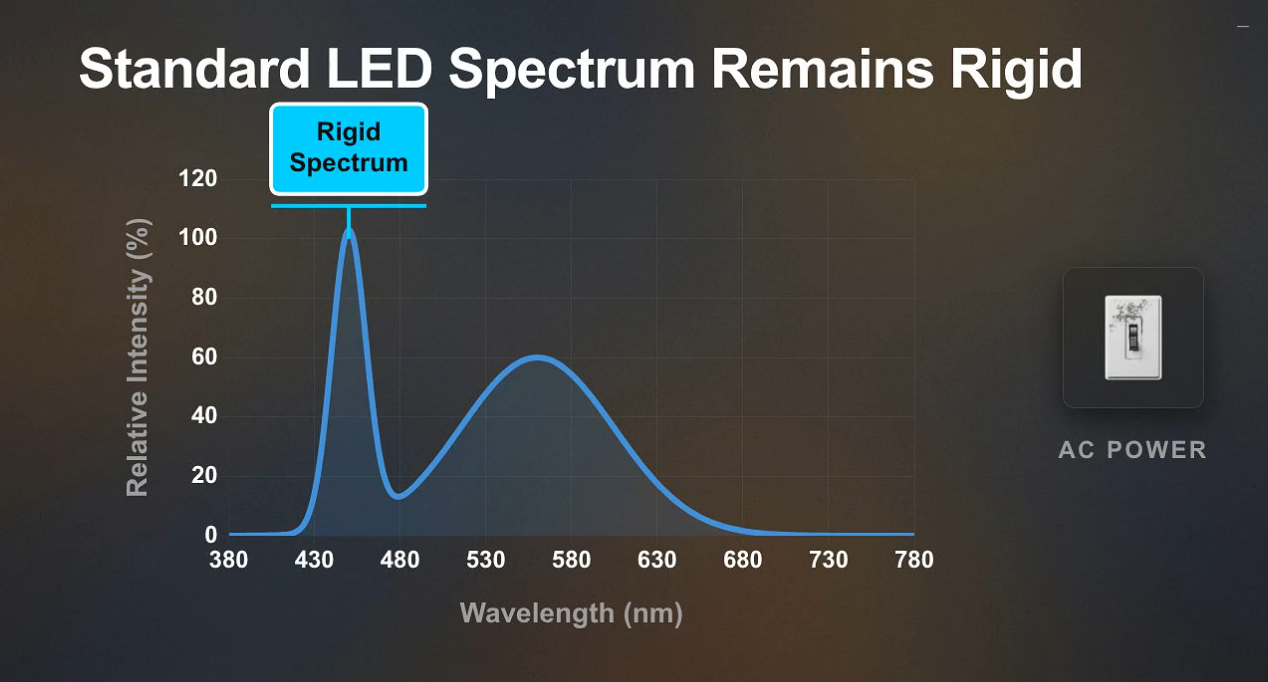
A spectral distribution graph illustrates how a standard LED produces a fixed and unchanging light output. The chart shows a sharp spike in the blue wavelength range around 450 nm, followed by a broader, lower peak across the mid-range wavelengths.
Labeled as a “Rigid Spectrum,” the graph highlights that traditional LEDs maintain the same spectral composition regardless of dimming, underscoring their limited adaptability to changing environmental or human lighting needs.
Solving the Long-Term Accuracy Problem
Maintaining this level of precision over time presents a major engineering challenge. Traditional LEDs gradually drift in color accuracy as they age. Ketra addresses this issue using a patented calibration technology known as Color Lock. Color Lock relies on closed-loop optical and thermal feedback systems that constantly monitor the light emitter inside the fixture. These sensors automatically make micro-adjustments in real time to maintain perfect color accuracy. The system maintains precision within one-step MacAdam ellipse tolerance.
A MacAdam ellipse represents a region on a color chart where variations in light color are indistinguishable to the human eye. By staying within this extremely narrow range, Ketra ensures every fixture remains visually identical across rooms, product families, and color temperatures. This continuous internal calibration guarantees that lighting accuracy remains stable across the fixture’s 50,000-hour lifespan.

A visual representation of a 1-step MacAdam ellipse, demonstrating the highest level of color consistency achievable in lighting systems. This level of precision ensures that variations in light output are virtually imperceptible to the human eye.
Advanced lighting solutions like Lutron Ketra utilize this level of accuracy to maintain uniform color across fixtures over time, eliminating mismatched tones and delivering a seamless lighting experience in luxury smart homes designed by Smarter Homes.
Evening Light Designed for Human Comfort.
As evening approaches, the lighting system gradually shifts into Dynamic Spectrum Mode, transitioning toward warmer tones that encourage relaxation. This behavior replicates the familiar dimming characteristics of traditional incandescent lighting. However, achieving this warmth requires a surprising engineering decision.
Rather than relying on traditional dimmers that reduce electrical voltage, Ketra fixtures require constant power. Instead of cutting electricity to dim the lights, every adjustment in brightness or color is controlled digitally and wirelessly through Lutron’s Clear Connect Type X communication network.
Lutron HomeWorks manages this constant power architecture, enabling sophisticated digital control while maintaining a seamless experience for the homeowner. By keeping the electrical supply stable, the system can tune lighting across an extremely wide range from crisp midday daylight down to ultra-warm candlelight tones around 1400K. The result is a soothing environment designed to support the body’s transition into rest.
A Unified Intelligent Ecosystem
Once installed, Ketra lighting integrates directly into the HomeWorks ecosystem. Lighting fixtures, motorized shades, and keypads communicate through a unified network, creating a coordinated system that responds automatically to the progression of the day.
Motorized shades track the sun's position. Interior lighting adjusts its color temperature and brightness accordingly. Scenes can also respond to occupancy, activities, or voice commands. The result is an architectural environment that remains continuously aligned with time, nature, and the biological rhythms of the people living within it.
The Future of Architectural Lighting
For generations, buildings have been static structures while human lives remained fluid and dynamic. Today, advanced lighting technologies are changing that relationship.
By combining astronomy, digital control, and precision engineering, responsive lighting systems allow architecture to adapt to the rhythms of the natural world and the people who inhabit it. When light evolves with us, the home itself becomes a living environment—one that supports clarity, creativity, rest, and wellbeing throughout every moment of the day.
FREQUENTLY ASKED QUESTIONS
What is responsive architectural lighting?
Responsive architectural lighting is a system that automatically adjusts light intensity and color temperature throughout the day to align with natural daylight patterns and human biological rhythms. Unlike traditional lighting, it evolves in real time based on environmental and astronomical data.
How is Ketra lighting different from traditional LED lighting?
Traditional LED lighting produces a fixed spectrum that does not change with time, even when dimmed. Ketra lighting uses advanced digital control and proprietary hardware to dynamically adjust both brightness and color temperature, creating a lighting environment that mirrors natural daylight from sunrise to sunset.
What does correlated color temperature (CCT) mean?
Correlated Color Temperature (CCT) refers to how warm or cool a light appears, measured in Kelvin (K). Lower values (around 1400K–3000K) produce warm, relaxing light, while higher values (5000K–10,000K) create cooler, more energizing daylight tones.
How does Ketra know how to adjust lighting throughout the day?
Ketra systems use an internal astronomical clock that calculates your home’s exact geographic location. This allows the system to automatically sync lighting conditions with real-time sunrise and sunset patterns—no manual scheduling required.
What is Vibrancy Mode and why is it important?
Vibrancy Mode enhances the appearance of colors in a space by adjusting the Spectral Power Distribution (SPD) of the light. This allows artwork, finishes, and materials to appear richer and more dimensional without altering the room's overall color temperature.
What is Color Lock technology?
Color Lock is Ketra’s patented calibration system that maintains consistent light color over time. Using real-time optical and thermal feedback, it continuously adjusts the fixture to prevent color shifting, ensuring long-term accuracy and uniformity.
What is a MacAdam ellipse, and why does it matter?
A MacAdam ellipse defines the range of color variation that is invisible to the human eye. Ketra maintains color consistency within a one-step MacAdam ellipse, meaning all fixtures appear perfectly matched—even after years of use.
Why do Ketra fixtures require constant power?
Unlike traditional lighting systems that dim by reducing electrical voltage, Ketra fixtures require constant power. All adjustments to brightness and color are controlled digitally via Lutron’s system, enabling greater precision, smoother transitions, and a wider range of lighting conditions.
Can Ketra lighting be installed in existing homes?
Yes. While new construction projects often use integrated architectural fixtures, Ketra also offers retrofit solutions like A20 lamps that can be installed into existing fixtures—provided the system is properly designed for constant power.
How does Ketra integrate with a smart home system?
Ketra integrates seamlessly with Lutron HomeWorks, allowing lighting, motorized shades, and keypads to operate as a unified system. This creates automated scenes that respond to time of day, occupancy, and user preferences.
Does responsive lighting actually impact wellbeing?
Yes. Lighting plays a critical role in regulating circadian rhythms, which affect sleep, mood, and energy levels. By mimicking natural daylight cycles, responsive lighting can support alertness during the day and relaxation in the evening.
How long does Ketra lighting maintain its accuracy?
Ketra fixtures are engineered to maintain precise color accuracy for up to 50,000 hours of operation. Thanks to Color Lock technology, they avoid the color degradation commonly seen in traditional LEDs.
Is this type of lighting only for luxury homes?
While commonly used in high-end residential and architectural projects, responsive lighting is ultimately about performance and experience. It is ideal for anyone prioritizing wellness, design precision, and long-term lighting quality.
What should be considered during planning and installation?
Proper system design is critical. Key considerations include:
Ensuring constant power to all fixtures
Eliminating traditional dimmer switches
Integrating with a control system like HomeWorks
Coordinating with architectural and lighting design plans
Working with an experienced integrator ensures the system performs as intended.
