Is Your Home Ready for Wildfire Season?
Summer in Central Texas is beautiful, but it also brings heat, drought, and an uncomfortable reality that more homeowners are facing: wildfire risk is no longer something that only happens "out west."
With ongoing development pushing deeper into the Hill Country, and Central Texas's well-documented history of drought cycles, the question isn't if wildfires can threaten our neighborhoods; it's whether our homes are prepared when conditions shift again. We've had a welcome stretch of rain lately, but anyone who's lived here long enough knows dry years are part of the rhythm. The time to prepare is while we have the breathing room
The good news? A few thoughtful changes can make a significant difference. And you don't need to turn your yard into a gravel wasteland to do it.
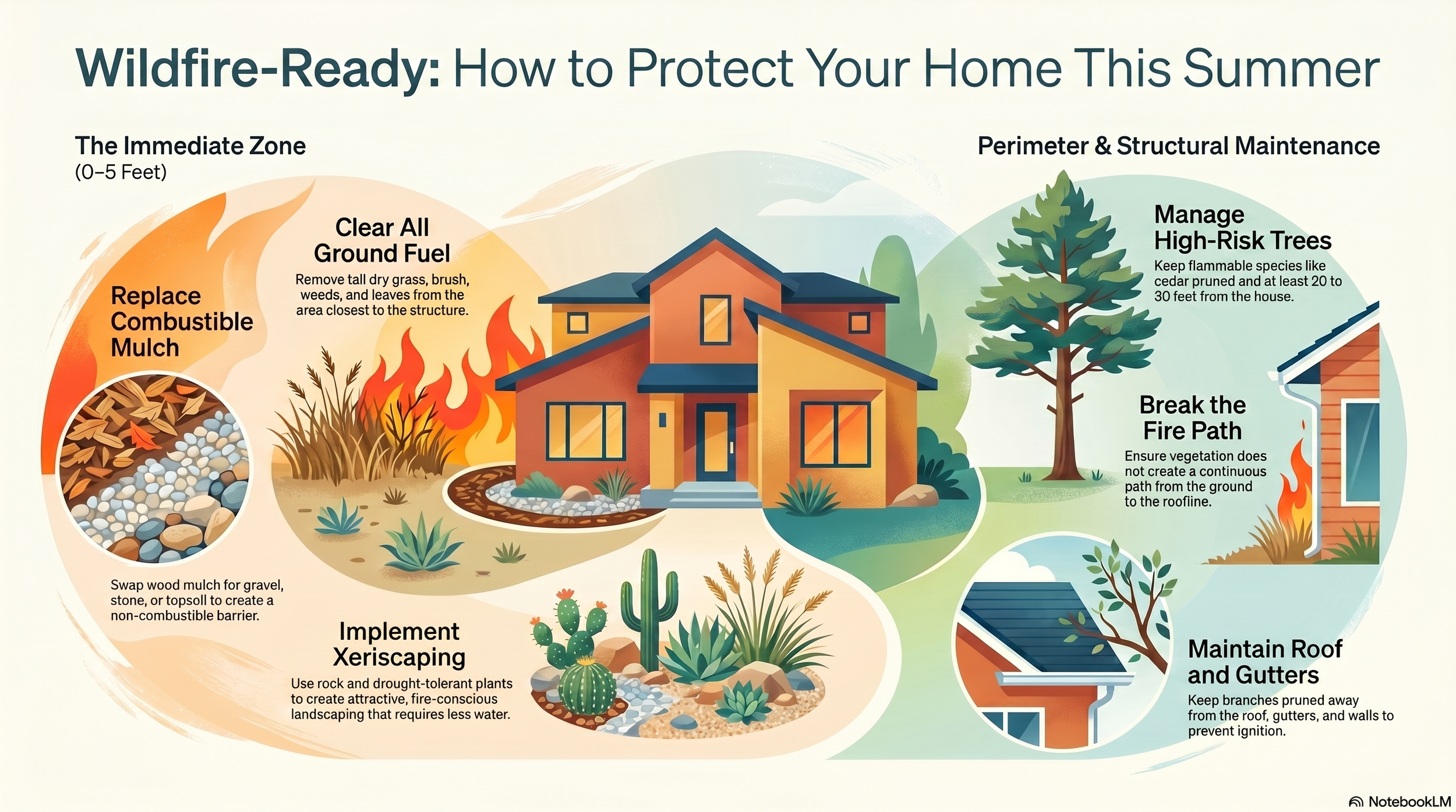
Wildfire-ready home protection guide showing how to reduce fire risk with gravel barriers, cleared brush, xeriscaping, tree maintenance, and clean roofs and gutters.
Think of Your Yard Like a Row of Dominoes
Here's a simple way to picture it: imagine a line of dominoes starting at your curb and ending at your front door. A wildfire moves the same way it travels from one fuel source to the next, getting closer and closer to your home.
The goal isn't to stop every domino. It's to pull the last few away from the house so the chain never reaches it.
But there's a catch: wildfires cheat. Strong winds carry embers that skip the dominoes entirely and land directly on your roof, deck, or flower beds. That's why protecting the space immediately around your home matters just as much as managing the yard overall.
The First Five Feet Are Everything
The most important zone is the ring of space within five feet of your home's exterior. Anything that catches fire here puts the entire structure at risk, fast.
One of the most common surprises for homeowners is that wood mulch in flower beds is a hidden hazard. During a dry Texas summer, even freshly watered mulch dries out within hours. When an ember lands in it, that mulch becomes a smoldering fire right next to your siding.
And here's where it gets counterintuitive: the fire doesn't have to touch your house to damage it. A small mulch fire three feet from your wall generates enough radiant heat to melt vinyl siding or shatter a window. Once a window breaks, embers blow straight into your home.
Simple swap: Replace wood mulch near the house with gravel, river rock, or topsoil. It looks clean, requires less maintenance, and removes the risk entirely.
Trees Are Beautiful, Until They're Not
Shade trees are a Texas summer essential, but the type of tree and its proximity to your home matter a lot.
Cedar and ash are among the most fire-prone species in our area, not because they look dry, but because healthy cedar is full of volatile oils that burn intensely even when green. The recommendation from wildfire consultants: keep these species at least 20-30 feet from your structure.
There's also a vertical dimension to think about. Fire can climb what experts call "ladder fuels": low vegetation catches, then a drooping branch catches, then suddenly flames are moving through the canopy and over your roofline. Pruning branches up and away from the ground breaks that ladder before they can form.
Xeriscaping: The Accidental Win
Here's where it gets interesting for Austin homeowners: the landscaping changes that reduce fire risk are almost identical to the ones that reduce water use.
Drought-tolerant plants, gravel pathways, and rock ground cover aren't just fire-smart; they're water-smart. If you've been thinking about xeriscaping anyway, wildfire prep gives you even more reason to make the switch. You get a more resilient yard on multiple fronts.
Where to Start
A casual walk around your property is a good start, but it's easy to miss where embers actually collect: roof valleys, under decks, inside gutters, and around AC units.
A few resources worth knowing:
Your local fire department can walk you through defensible space recommendations specific to your neighborhood.
Home Health Intel (available on iOS and Android) is an app designed to help homeowners systematically audit their property for fire vulnerabilities, the hidden spots a casual look might miss.
For a more comprehensive evaluation, Tarrytown Roofing offers a wildfire-resistant package that assesses your home's defenses from the roof down, which makes sense, since the roof is the largest ember-landing surface on your property.
The Bigger Picture
At Smarter Homes, we think a lot about how the places we live can be designed to work for us, not just look good, but actually perform. Wildfire preparedness fits right into that philosophy. It's not about fear. It's about making smart, proactive decisions that protect your investment and your family.
A few changes today, swapping mulch, trimming branches, and auditing your immediate zone, can mean the difference between a manageable situation and a devastating one.
Take a walk around your property this week. Look past the curb appeal and ask: where are my vulnerabilities?
Smarter Homes serves the Austin and Westlake communities with smart home integration and technology solutions. We believe the best home is one that's both intelligent and resilient.
