What Smarter Homes Learned About Sonos at CEDIA 2026
The $3 Million Echo Chamber
Picture a $3 million home with floor-to-ceiling glass, imported Italian marble, and perfectly minimalist drywall. Visually, it's a masterpiece. Acoustically, it's a very expensive bathroom.
Every hard, flat surface sends sound bouncing around the room, and even a premium audio system can turn into a muddy, echoing mess. That tension between clean design and acoustic reality is exactly what our team at Smarter Homes went to CEDIA Expo 2026 to dig into.
We spent our time in the pro training sessions, on the show floor, and with Sonos' latest hardware. Below, we separate what Sonos officially confirms in its specs from what we learned firsthand about integrating these systems into real homes built with stone, steel, glass, and concrete.
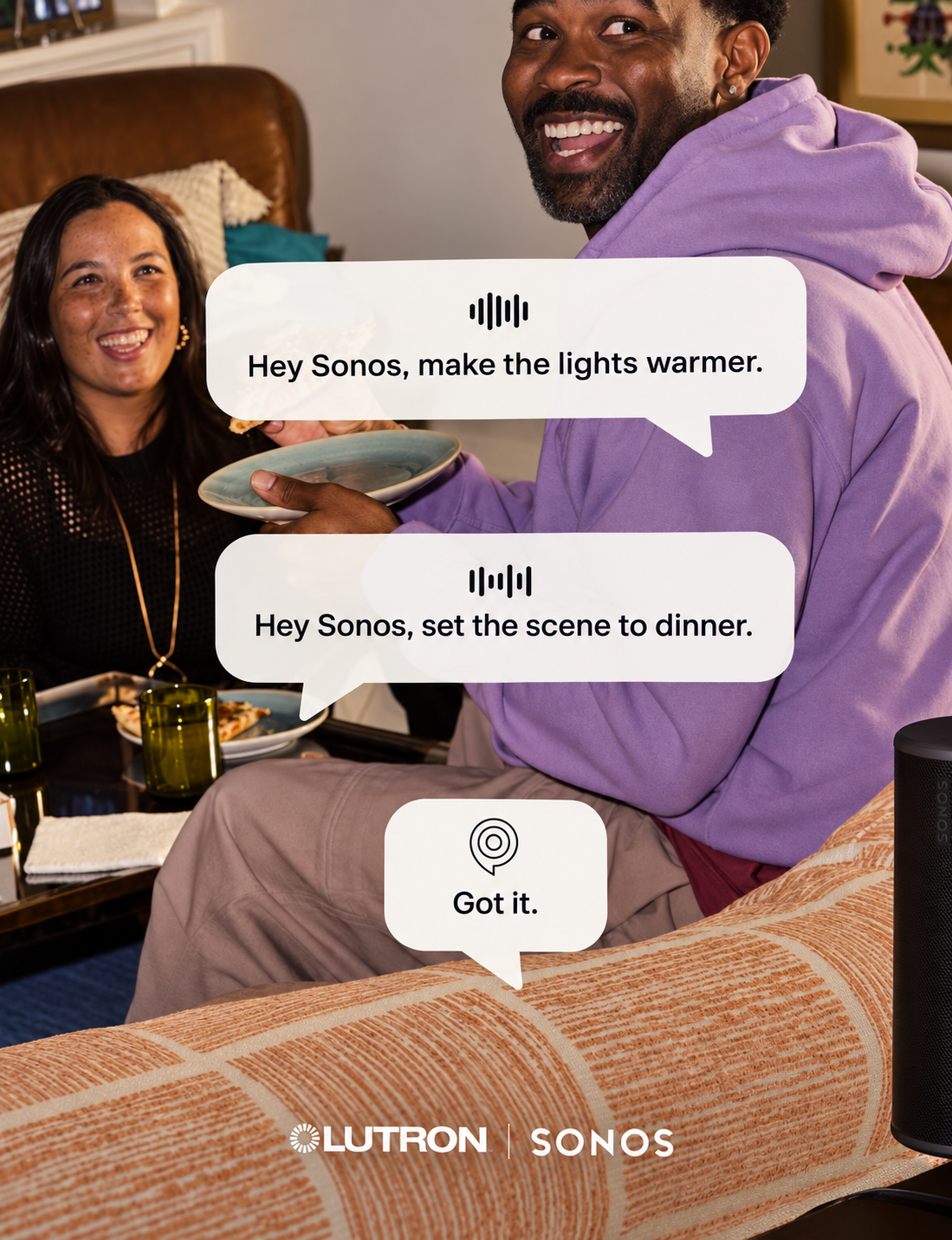
Sonos and Lutron come together to create a more connected home experience, bringing audio, lighting, and scene control together through simple voice commands.
If Sonos Is Plug-and-Play, Why Hire a Pro?
Sonos earned its reputation by being simple. Buy a speaker, plug it in, join your Wi-Fi, and you're listening in minutes. That works beautifully in an apartment or a single room.
It stops working at architectural scale. In a large luxury home with many zones, indoor-outdoor transitions, and dense structural materials, consumer Wi-Fi and scattered power cords fail fast. The music drops out on the patio, the kitchen loses signal, and cords end up dangling in places no designer would approve.
A professionally designed system leaves the plug-and-play model behind. It uses hidden architectural speakers, centralized equipment racks, dedicated structured wiring, and precise software tuning. In other words, the audio becomes part of the house itself.
The Aero 100 Pro: One Cable, No Outlet Hunting
Placing a wireless speaker usually means playing "where's the nearest outlet?" That game forces acoustic compromises just to reach a plug.
The Aero 100 Pro, which we saw installed on the show floor, ends that game. Its defining feature is Power over Ethernet Plus (PoE+). A single Cat5e-or-better Ethernet cable delivers both electrical power and a rock-solid data connection. In person, the result is striking: a speaker mounted cleanly on the wall with no cord running down to a baseboard.
For builders, this matters well beyond looks. Running low-voltage cable through studs costs far less and is less heavily regulated than adding high-voltage outlets in every corner where a speaker might go. The speakers can sit in cabinetry, high in a room's corners, or across a commercial space, all powered from a network switch in a closet down the hall.
The mount is built for professionals too:
Coverage: Sonos specs 240 degrees of horizontal coverage with dual-angle tweeters.
Indexed ball joint: Integrators can lock in an exact angle and repeat it across 20 speakers so every one matches.
Threaded safety insert: A secondary attachment point on the backboard supports building codes that call for seismic safety tethers.
Zone grouping: Sonos confirms multiple Aero 100 Pros can be grouped to behave as one zone, so a homeowner manages one volume control instead of twenty.
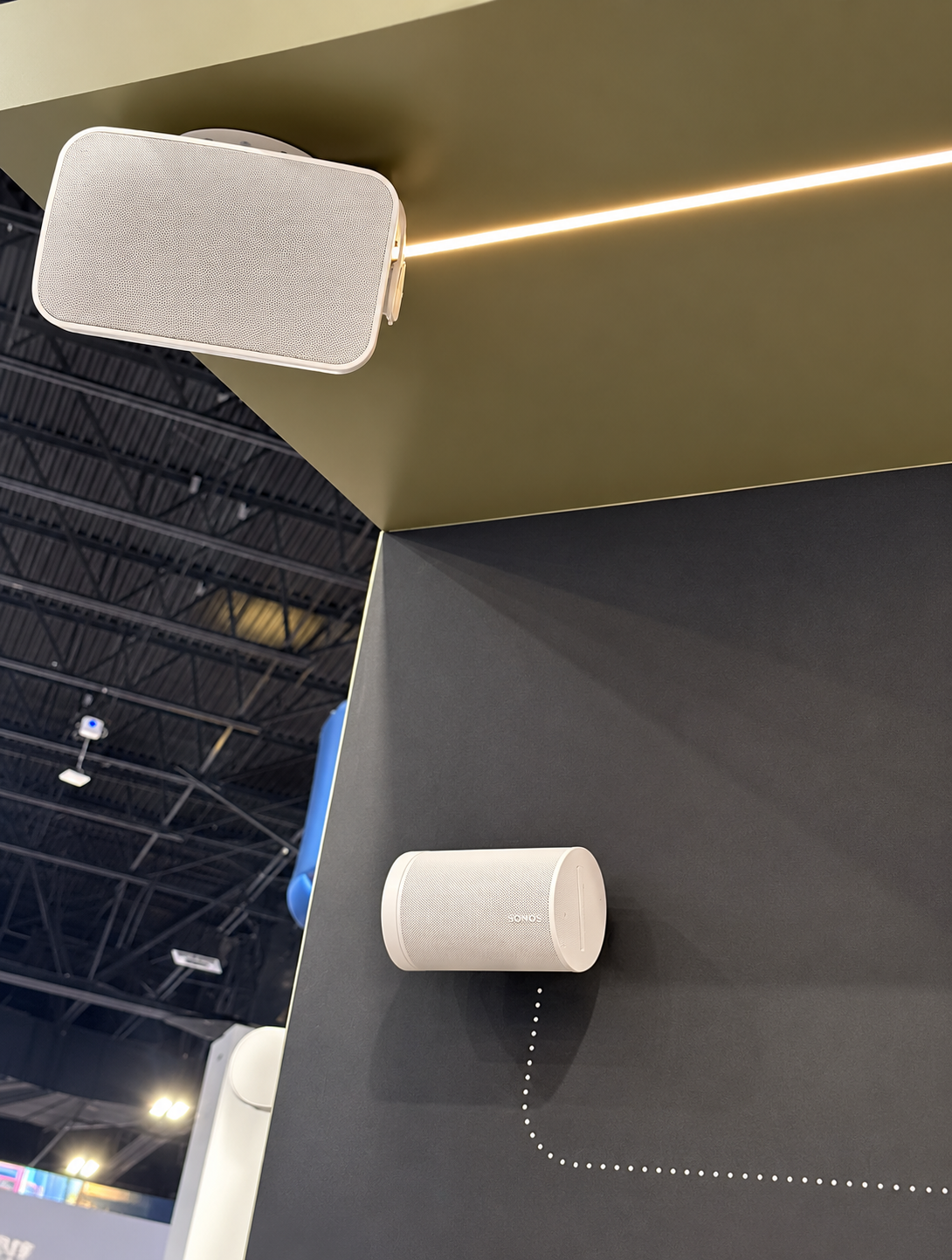
Sonos speakers on display showcase flexible mounting options designed to bring powerful, seamless audio into professionally integrated spaces.
The Sonos Amp and the Rack: Where Home Audio Becomes Enterprise IT
The most elegant sound is the kind you can't see. That's the job of the Sonos Amp, which delivers 125 watts per channel. It lives in a central equipment rack and powers passive speakers flush in the ceiling, behind drywall, or tucked into the landscaping by the pool.
The CEDIA training made one thing very clear: a rack full of amps needs real network discipline.
Hardwire everything. Ten amps stacked in a metal rack create a dense cluster of wireless interference. The metal reflects signals, devices talk over each other, and Wi-Fi bridging collapses. Rack-mounted amps must be wired.
Respect the daisy-chain limit. You can link amps to each other with short Ethernet runs, up to a physical limit of seven. The professional recommendation taught at CEDIA is no more than four, because you never want to push a network bridge to its edge.
Configure Spanning Tree Protocol (STP). When network traffic loops, switches can copy the same packet endlessly in milliseconds. That's a broadcast storm, and it can choke the entire network. STP acts as a supervisor: managed switches exchange small monitoring messages every two seconds, map the network, and block redundant paths before a loop forms. For Sonos, integrators enable STP on the switch and set its bridge priority to 4096. That makes the switch the clear authority on the network, so audio traffic stays stable even when a laptop is pulling down a huge file.
-
Imagine spending $3 million on a highly curated movie. You know, you've got floor-to-ceiling glass windows, imported Italian marble floors, perfectly minimalist
drywall.
Right. Visually, it's an absolute masterpiece.
Exactly, a masterpiece, but acoustically, you have essentially just built a giant bathroom. Yeah,
you really have. Sound waves are just-they're waiting to bounce off all those hard, flat surfaces, and it turns a high-end audio setup into a muddy, echoing
mess. It's the worst, and that tension, that fight between esthetic purity and acoustic reality, is exactly our focus today. So welcome to the deep dive, everyone.
Glad to be here.
You handed us this massive stack of notes from the Smarter Homes trip to the Cedia Expo 2026, and we've got you know official tech specs, boots on the ground photos, training manuals.
Yep, it's a lot to unpack. It
is. So our mission today is to filter all of this through one very specific question, which is, what did Smarter Homes actually learn about Sonos at CBO 2026? Why does it matter when you're designing audio for a modern luxury home?
Which is a great question.
And we really need to separate what we personally experienced in the pro training sessions from, you know, what Sonos officially confirms in their specs.
Right, and also separate that from the brand new products that were just announced around this time, like the R ultra and the ultra.
Exactly,
because we want to bypass the marketing brochures here. We're looking at the practical, hard-learned realities of well, of integrating these systems into complex building materials like concrete and steel.
Totally. But before we get into the heavy network engineering and the new hardware. I kind of want to address a fundamental contradiction here.
Okay, what's that?
Well, Sonos is famously known for being like the ultimate plug-and-play consumer product, right? Almost anyone can walk into a big box store, buy a standard Sonos speaker, plug it into a wall outlet, connect to Wi-Fi, and bam, it works.
Right. It's incredibly user-friendly on that end.
So if the consumer here is that simple, why would you like? If you're a luxury homeowner or a builder, why go through the massive trouble and expense of hiring a professional integrator?
If we take this to the bigger picture, it really comes down to architectural scale, and frankly, the limitations of consumer-grade infrastructure.
What do you mean by limitations?
Well, in a sprawling luxury home where you've got multiple zones, indoor and outdoor transitions, really dense structural elements, standard Wi-Fi and scattered AC power cords fail rapidly. They just don't cut it.
Oh, sure, you lose signal in the kitchen, and suddenly the patio music drops out.
Exactly. So a professionally designed system abandons that plug-and-play model entirely. It relies on hidden architectural speakers, centralized equipment racks, dedicated structured wiring, and precise software tuning.
You're basically integrating the audio ecosystem directly into the physical framing of the house.
Exactly.
Okay, so let's start with that physical framing, specifically how we actually get power and data to speakers without ruining the interior design.
Right, classic. Where is the outlet process?
Yes, because typically finding a place for a wireless speaker means playing the where is the nearest electrical outlet game, and that usually forces you to compromise on acoustics just to reach a plug.
And this brings us to our first major piece of hardware smarter homes documented on the CBS show holt, the Aero 100 Pro. Okay,
yeah, let's talk about that.
So this is a speaker meant to be visible but elegant, and the defining feature that separates the Pro model from the consumer version you buy at retail is a technology called POE or Power over internet.
Yeah, I was looking at your videos from the event, and the cleanliness of the inspiration is just a flight gallif. The speaker is mounted directly to the drywall, but there is absolutely no AC power cord dangling down to a baseboard.
Because it doesn't want AC power at all. POE Plus allows a single Category Five or higher Ethernet cable to deliver both the electrical current and a rock solid data connection to cycle data.
wow! So just one thin wire doing both.
Exactly. And from a construction standpoint, running low voltage Ethernet cable through studs is vastly cheaper, and it's less heavily regulated than bringing in a licensed electrician to throw high voltage roll next to every single corner of the room where you might want a speaker.
Oh, that makes. can
seamlessly integrate these into cabinetry or mount them high up in the corners of commercial retail spaces. And
all of it powered by a network switch and a utility closet down the hall.
Yep, exactly. But
beyond the wiring, I noticed the physical hardware of the mount we saw at CDO really reflects that professional focus too.
Yeah, the official specs for the Aero 100 Pro highlight its 240-degree horizontal coverage and dual-angle tweeters. But the mount itself-that's where it gets really interesting for integrators. It utilizes an indexed ball joint.
Oh, so you can lock in the exact angle.
Right. It allows an integrator to lock in the exact articulation angle, which ensures repeatability across, say, 20 speakers in a large commercial space. They all match perfectly. Okay. The
notes also mentioned a threaded insert on the backboard optimal.
crucial structural detail for commercial applications, or for homes in earthquake-prone areas.
Oh, right, seismic safety.
Exactly. Building codes often require a secondary safety attachment point for seismic events. It ensures the speaker doesn't become a literal projectile at the primary mail field.
That's a very pro level detail.
It is, and from the software side, Sonos officially confirmed Aero 100 Pro supports dedicated zones. So instead of managing 20 individual volume sliders at the moment, an integrator groups multiple Aero 100 Pros to act as a single unified operating network. So PoE Plus basically solves the problem of visible speaker, but if the basic high-end design is often the illusion of using something from nowhere, like creating physical audio, how do professionals manage that? For that, we have to move our attention away from the living spaces entirely. Look inside the centralized equipment. Okay, off to the basement we go. And this is where the Sonos amp operates. It officially retails for $799. It packs 125 watts per channel, and it basically serves as the rack-based brain of the hidden system.
Got it.
So it provides the streaming intelligence plus the physical amplification derived passive, non-powered architectural speakers, like the ones flushed in the ceiling or hidden behind drywall.
Exactly, or the ones buried in the landscaping out by the pool. The
physical speakers remain completely out of sight, while the amps sit stacked in a metal utility rack in an AV closet. Reviewing the notes from the standard conveying
training at CEDIA, getting into scanning tree protocol feels like we are leaving residential tech and entering enterprise IT. Why is a rack of amps so volatile that it requires enterprise level traffic? Why can't we just, you know, plug 10 amps into a standard switch and rely on the home's Wi-Fi? What's fascinating here is that doing so will trigger a catastrophic network failure,
known as a broadcast storm.
A broadcast storm. That sounds bad.
It's terrible. If you put 10 amps into a metal equipment rack, you are creating a dense cluster of wireless interference. The metal reflects the signals. The devices literally talk over each other, and the Wi-Fi bridge just collapses. They absolutely must be hardwired.
Okay, but the CDA training made it clear that even hardwiring them requires strict discipline. Let's unpack the daisy chain rules. The notes say if you are linking amps together using short Ethernet cables from one to the next, the absolute physical limit is seven units.
Yes. However, this is a big however. The strict professional recommendation taught at Cedia is no more than
four. Four. Why the difference?
Because you never want to push a network bridge to the honestly.
And to guarantee that stability, the training heavily emphasized span tree protocol or STP. Can you write down the mechanism of a broadcast form and how STP solves it? Sure.
Imagine a digital environment where two automated sorting machines accidentally forward the same data package each other into exactly and because network switches operate in milliseconds, milliseconds, the entire network is buried in billions of copies of that single redundant packet. It chokes all the bandwidth in the whole system crash.
Wow!
So STP acts as like the supervisor that physically unplugs one of the machines the moment it spots a loop. Precisely, managed network switches send out tiny monitoring signals for BPDUs, fridge protocol data use. Every two seconds, they map the network and actively block redundant paths to prevent those infinite loops. But pro integrators have to go into the switch zone and configure it specifically for solar, right? Yeah, they must enable SDV, set the path cost to short, and
change the BBB enabling to flood it. Okay, and the most specific metric from the training was the priority assignment. Integrators are told to assign a priority value of 409. Why So it gives it the absolute right of way. Exactly, it gets priority over lower level traffic, like say a laptop downloading a file, without that configuration, your home network will eventually buckle under the
audio data load. Because for over a decade, Sonos devices relied on a proprietary wireless mesh called Sonos. It
was their own invisible wireless grid, because honestly, early home Wi-Fi routers. But
at Cedia, the smarter host here saw a brand new software toggle demonstrator: the Disable Sonos Net Wizard.
Yep, and officially, newer Sonos products do not even contain the hardware to support the old Sonos Net mesh.
That's a huge shift.
The technology has evolved to a point where proprietary mesh systems are basically obsolete.
Completely.
The industry is moving toward relying on a robust, hardwired enterprise-grade network with really strong Wi-Fi six environments. That disabled Sonos Net Wizard lets a professional shut down a legacy mesh open wide with one tap, causing
drastically reduces wireless interference. Okay, so we've established the rules for putting the brains in a distant metal bag, but that creates a massive physics problem when you finally sit down in a living room or dedicated medium room.
The whole theater setup.
Yeah, your TV soundbar cannot be interactive. It has to be mounted directly. This
is where we look at the newly announced hardware smarter homes experienced around the time of CBM, specifically the Arc Ultra, which officially sits at $1,099.
Okay, I have to push back a bit on the official specs for the Arc Ultra because Sonos is claiming it delivers a 9.1 point four Dolby Atmos spatial audio experience from a single physical soundbar.
They are indeed.
And my immediate thought is, this is just clever audio math, right? Like you cannot cheat physics. How do you get 14 speakers worth of sound from one enclosure?
Well, it's heavily reliant on acoustic engineering rather than just digital processing. Sonos officially confirms it houses 14 distinct custom engineered drivers.
Wait, 14 actual physical drivers?
Yes, and to achieve that 9.1 point four immersion, it utilizes side-firing drivers that physically bounce sound waves off your side drywall to create width, and dedicated upward-firing drivers that bounce sound off your ceiling to create the overhead atmosphere effect.
Okay, but what about the bass? The defining innovation heavily featured in the sources is sound motion technology, and physics dictates that to generate deep bass, you must move a large volume of paper, which traditionally requires a deep, bulky, cone-shaped woofer.
Right, the traditional big subwoofer box.
Yeah, but Sound Motion uses a completely flat woofer. How does a flat speaker generate massive bass pressure?
It's a complete redesign of the transducer. Sound motion uses four separate motors driving dual membranes.
Okay, so instead of pushing outward like a traditional code,
right? They operate in a push-pull configuration, compressing the air laterally within the enclosure. It flattens the physical speaker while still generating the massive air pressure required for cinematic
bass. Oh wow! With the design implications for a luxury home are huge. There, by flattening the woofer, the sound bar remains incredibly sleek and low profile, so it doesn't block the bottom edge of a modern ultra-thin TV.
Exactly, and furthermore, by shrinking the physical size of the base components, Sanos freed up critical internal volume within the chassis, so they packed in more tweeters and mid-range drivers, creating a much wider, clearer soundstage.
That's wild, but integrating the Arc Ultra brings us back to the strict networking rules taught at CDF.
Yes, the
hierarchy. Setting up a home theater requires adhering to a rigid hierarchy of primary and secondary classes. The Arc Ultra under the
And the subwoofers or Sonos amp driving in ceiling rear surround speakers. Those are the secondary devices.
And the training revealed an unforgiving network handle for this exact setup. Like a homeowner or builder might think, you know, down in the picture, but. If
they do that, the system will fail completely.
Completely.
Yes. The rule is absolute. If any of your secondary devices are hardwired to the network, your primary device, the Arc Ultra, must also be hardwired. You cannot have wired to. You can, but then you run into a strict distance limitation dictated by physics. If the amp powering your rear speakers is trying to connect wirelessly to the Arc Ultra. That amp must physically reside within 30 feet of the soundbar.
Just 30 feet.
Yep, it needs to catch the soundbar's dedicated 5 gigahertz signal.
And the 5 gigahertz frequency can carry a massive amount of data very quickly, which you need for uncompressed surround sound. But higher frequency waves are physically tolerable.
Exactly, which means if your equipment rack is in a basement closet 50 D away, wireless integration is impossible. Architects and integrators must understand. So, what does this all mean for
the everyday experience of the family living in the house, we've covered PoE plus cables, STP priorities, five gigahertz limits, but eventually someone just sits on the couch with a remote.
Right, the actual user experience.
Yeah, and this brings us back to our initial problem: the $3 million acoustic bathroom. You can install an Arc Ultra and the best architectural speakers in the world, but the modern glass and marble esthetic will destroy the audio quality.
This raises an important question about acoustics, and that is where the software tuning becomes as critical
as the hardware. TruePlay is the acoustic measurement software that basically uses the microphone on your phone to analyze how sound waves reflect off the specific surfaces in your room,
so it measures the decay time of the frequencies bouncing off the glass of marble.
Exactly, and then it applies a corrective EQ to the speakers. It aggressively pulls back the frequencies that are bouncing too much and boosts the ones being absorbed by the front.
That's brilliant. It forces the arrow ones of a very odds in a commercial space or the arc ultra in a living room to sound accurate to the specific architectural constraints of that room.
To bear leading on international
tuning, the official ecosystem features focus heavily on eligibility, like speech enhancement, which uses AI processing to detect human vocal frequencies and push the dialog forward in the mix. Oh,
I need that. And night sound, right, which compresses the dynamic range, bringing up quiet whispers and suppressing loud explosions, so you don't wake the rest of the house.
Exactly.
My personal favorite feature in the notes regarding everyday luxury is the TV audio swap.
Oh, that's a great one!
Right, so you're watching a movie late at night in the primary bedroom or media room, and someone else is trying to sleep. With a single button press, you can instantly swap the audio from the Arc Ultra soundbar directly to the new Sonos Ace headphones.
And you'ren't just getting downgraded stereo sound. The mechanism transfers the full 9.1.4 spatial audio mix with dynamic head tracking.
Dynamic head tracking.
Yeah, it anchors the audio to the physical location. As you turn your head to say, grab a drink from the side table, the center channel dialog stays locked to the screen in front of
you. Wow! So it feels like the sound is still coming from the TV. It is
a deeply immersive private cinematic experience that requires.
Okay, we have dug deep into the technical realities of modern audio integration today, from broadcast forms, the rack to the lateral air compression of sound motion. So, looking at everything Smarter Homes documented, let's distill us into the five most actionable takeaways for anyone designing or building a high-end space based on what was learned at CEDIA 2026.
Let's do it. The first major operational shift at POE
Plus is the new
standard for visible audio. The Aero 100 Pro proves that delivering power and data over a single category Ethernet cable is cleaner, vastly cheaper for builders, and allows for infinite placement flexibility compared to traditional AC electrical wiring.
The second takeaway is that rack-mounted audio demands enterprise-level network engineering. You cannot just stack Sonos amps and rely on consumer Wi-Fi. Integrators must hardwire the system, follow the strict four-unit Daisy chain adaptation, and configure spanning tree protocol with priority 4096 to prevent catastrophic broadcast storms.
Exactly, and the third takeaway revolves around the physics of bass. Sound motion technology proves that you no longer need massive, room dominating wooden boxes for cinematic audio. The Arc Ultra's flat four motor push pull woofer delivers deep 9.1 point four Dolby Atmos base from a chassis slim enough to disappear under a modern TV.
Love that. The fourth takeaway is that home theater networking rules are unforgiving. In any hybrid setup, if your secondary devices like rear surround amps are hardwired, your primary sound bar must also be hardwired. And if you go entirely wireless, you must respect the 30-foot physical limitation of the 5 gigahertz frequency.
And finally, the fifth takeaway is the death of the legacy
mesh. The
era of Sonos Net is over, with new hardware dropping support and integrators utilizing the new system-wide disabled wizard. The future of wireless audio relies entirely on robust, professional-grade home networks and Wi-Fi six environments.
It's a complete evolution of how residential technology is deployed. Really, it is no longer an afterthought. It is foundational infrastructure planned alongside the plumbing and HVAC.
It is, and it leads to a fascinating philosophical shift for modern architecture. Honestly, as audio technology physically hides itself within the framing of our homes, whether that's through low voltage POV plus cables running inside the walls, or flat sound motion motors manipulating air pressure to save space.
We are getting closer to the invisible concert hall.
We really are. Will the ultimate luxury in future smart home design simply be the ability to hear absolutely everything perfectly while seeing absolutely nothing at all.
That is the perfect question to leave you with. Keep those blueprints in mind. Thanks for joining us for this deep dive, and we'll catch you on the next one.
Goodbye, SonosNet
For more than a decade, Sonos relied on SonosNet, its own proprietary wireless mesh. It existed because early home Wi-Fi routers simply weren't reliable enough for multiroom audio.
That era is ending. At CEDIA we saw a new Disable SonosNet wizard that lets an integrator shut down the legacy mesh across a system in one step, cutting wireless interference significantly. Sonos also confirms that newer products don't include the hardware to support SonosNet at all.
The direction is clear. Reliable Sonos performance now depends on a robust, professionally designed network: hardwired where it counts, with strong Wi-Fi 6 coverage everywhere else.
Arc Ultra: Big Theater Sound From a Slim Bar
The soundbar is the one component that can't hide in a closet. It has to sit right at the screen. That's where the Arc Ultra comes in.
Sonos says the Arc Ultra delivers 9.1.4 Dolby Atmos from a single bar. That sounds like marketing math until you look inside. It houses 14 custom drivers. Side-firing drivers bounce sound off the walls to create width, and upward-firing drivers bounce sound off the ceiling for overhead effects.
The real breakthrough is the bass. Deep bass normally requires moving a lot of air, which means a big, deep, cone-shaped woofer. Sonos' Sound Motion technology replaces that with a flat woofer: four motors drive dual membranes in a push-pull arrangement, moving air sideways inside the enclosure instead of pushing outward.
For a luxury home, this has two big design benefits. The bar stays slim enough not to block the bottom edge of a modern ultra-thin TV. And because the bass hardware takes up less room, Sonos had space for more tweeters and midrange drivers, which creates a wider, clearer soundstage.
Home Theater Networking Rules Are Unforgiving
A Sonos home theater follows a strict hierarchy. The soundbar, such as the Arc Ultra, is the primary device. Subwoofers, or a Sonos Amp driving in-ceiling rear surrounds, are secondary devices.
Two rules from the CEDIA training are non-negotiable:
If any secondary device is hardwired, the soundbar must be hardwired too. A builder might assume wiring just the rear amp is fine. It isn't, and the system will fail.
If you go wireless, stay within 30 feet. A wireless amp powering the rear speakers has to pick up the soundbar's dedicated 5 GHz signal. That frequency carries the large amount of data surround sound needs, but it doesn't travel far or pass well through walls. If your equipment rack sits in a closet 50 feet away, wireless surround is off the table.
This is exactly the kind of decision that has to be made at the blueprint stage, not after the drywall is up.
Solving the Glass-and-Marble Problem: Trueplay and Everyday Luxuries
Back to our $3 million echo chamber. The best hardware in the world still can't overcome a room full of glass and stone on its own. That's where software tuning becomes just as important as the equipment.
Trueplay uses a microphone to measure how sound reflects off the surfaces in a specific room. It then applies corrective EQ, pulling back frequencies that bounce too much and lifting the ones that get absorbed. The result is accurate sound tuned to that room's architecture, whether it's an Arc Ultra in a living room or a set of Aero 100 Pros in a commercial space.
Sonos also includes several features that make daily life better:
Speech Enhancement uses AI processing to pick out voices and bring dialogue forward.
Night Sound narrows the dynamic range, raising quiet whispers and taming explosions so you don't wake the house.
TV Audio Swap sends the soundbar's audio to Sonos Ace headphones with a single button press. You keep the full spatial mix, and head tracking keeps dialogue anchored to the screen even as you turn to grab a drink. It's a private cinema experience while everyone else sleeps.
Why Texas Is the Best Place to Build a System Like This
Everything we learned at CEDIA applies anywhere. But Texas homes, and Central Texas homes in particular, are where these technologies shine brightest.
We build new, and we build big. Austin, Westlake, and the surrounding Hill Country keep adding new custom homes and major remodels. New construction is the ideal moment for PoE+ speakers, structured wiring, and a central rack. Running low-voltage cable through open studs is simple and affordable. Retrofitting it after the drywall goes up is not. Larger floor plans with many zones are also exactly where consumer Wi-Fi falls short and professional design pays off.
Our architecture is beautiful and acoustically difficult. Hill Country limestone, polished concrete, steel beams, and walls of glass framing the view are signature Central Texas design. They're also the hard, reflective surfaces that create the echo-chamber problem. Hidden architectural speakers, the Arc Ultra's slim profile, and Trueplay tuning were made for these rooms.
We live outside most of the year. Long warm seasons mean Texans use patios, outdoor kitchens, pool decks, and covered porches far more than people in colder climates. That makes seamless indoor-outdoor audio a must, along with landscape speakers powered by rack-mounted amps that stay out of the weather.
Our climate rewards a central, protected rack. Texas heat, summer storms, and an unpredictable power grid are hard on electronics scattered around a house. Centralizing amps and PoE switches in a well-ventilated equipment rack, paired with proper power protection and backup, keeps the whole system cooler, safer, and easier to service.
Texans expect to entertain. Game days, holiday gatherings, and backyard parties are part of the culture here. A properly engineered system lets music follow guests from the kitchen to the pool without a single dropout.
You have local experts close by. As an Austin-area integrator serving Austin and Westlake, Smarter Homes designs for local building styles, local climate, and local builders. We work alongside architects and contractors from the blueprint stage so audio is planned with the plumbing and HVAC, not added at the end.
Building or remodeling in Austin or Westlake? Bring Smarter Homes in at the blueprint stage. We'll design a Sonos system that fits your architecture, your network, and the way your family lives, inside and out.
