The Black Box on the Beautiful Wall
Picture a living room where every detail has been chosen with care: matched wood grain, Italian veneers, custom paint on the trim, and lighting set just right. Then, right in the middle of it, someone hangs a shiny black plastic speaker.
It breaks the whole look. For years, that was simply the trade-off for good sound.
At CEDIA Expo 2026 in Denver, our Smarter Homes team spent time with Leon Speakers, a Michigan company built around ending that trade-off. A simple sign at the booth summed up its approach: sound to match any style. Rather than designing rooms around speakers, Leon designs speakers around the room. Here's what we learned.

Built to Order, Not Pulled Off a Shelf
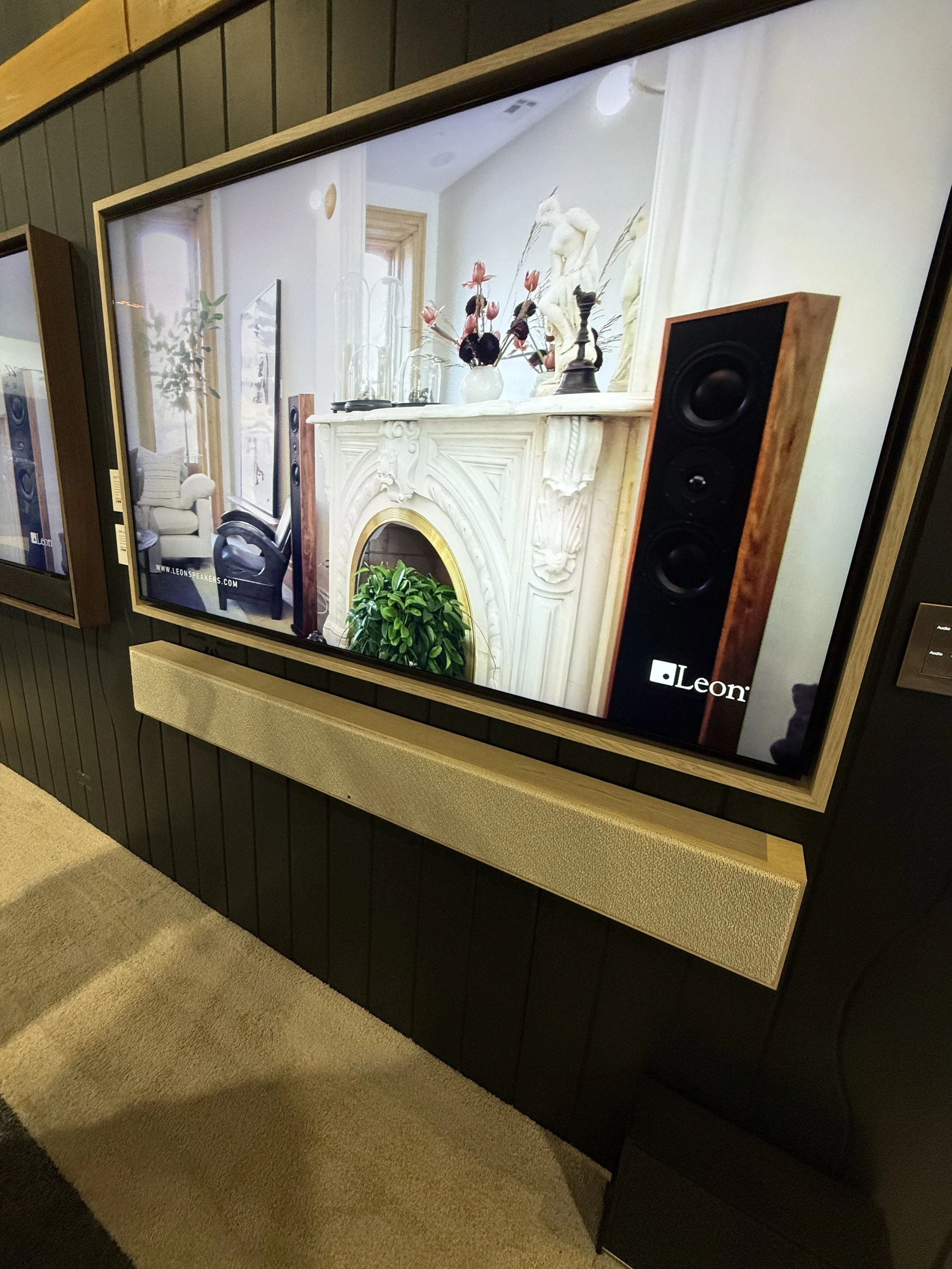
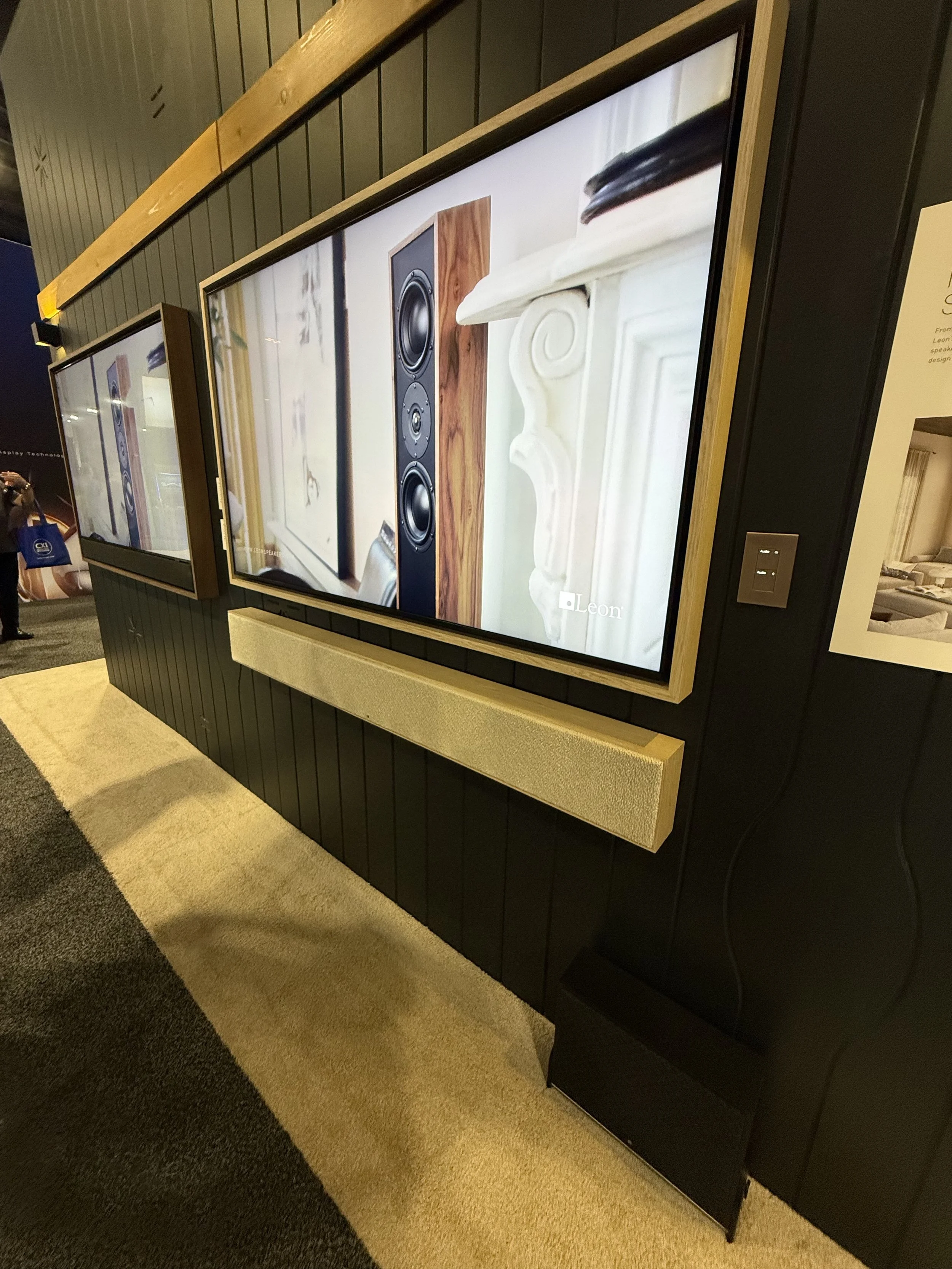
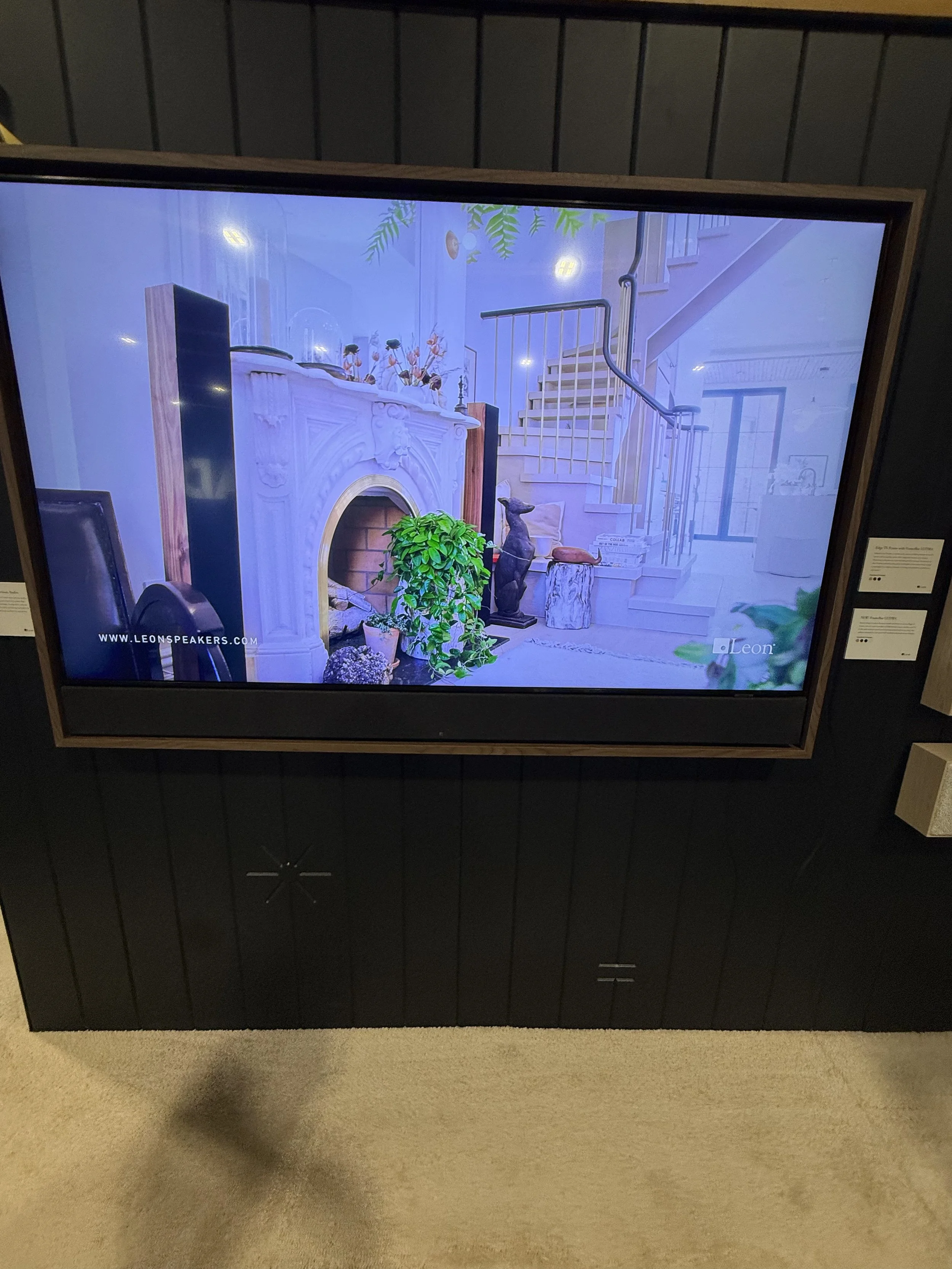
One of the displays we photographed showed a TV in a light wood frame with a soundbar beneath it, wrapped in a soft beige fabric. It didn't look like electronics. It looked like custom furniture, with the frame and soundbar flowing together as one piece.
That's possible because Leon doesn't mass-produce speakers. Each piece is built to order in its Michigan workshop. When we specify a Leon soundbar for a client, it's made to the exact width of that client's TV, so the two line up perfectly.
Leon has done this for years with product lines like its Horizon soundbars. What's changing is how far the customization now goes, and how many places in the home it reaches.
What's New for 2026
Alongside its established products, Leon introduced several new pieces at CEDIA:
Studio Frame for Sony BRAVIA. A refined frame designed for Sony's latest BRAVIA 7 II and 9 II TVs, so the screen feels like part of the room rather than an appliance on the wall.
FrameBar Ultima. A custom-width soundbar built for framed TVs, bringing Leon's highest-performance sound to the popular "TV as art" look.
Terra outdoor speakers. Leon's design-first approach now extends to patios, gardens, and outdoor living spaces.
A new Material Library. A refreshed collection of wood finishes and exclusive grille fabrics that makes it easier to coordinate Leon pieces across an entire home.
Speakers as a Design Finish
Leon treats a speaker like a designer treats cabinetry or flooring: a finish chosen to suit the room.
Standard finishes include light oak, walnut, and several black-and-white options.
Custom matching goes much further. Leon can match a specific paint color or stain a speaker to match wood veneers sent from the job, so the speaker looks like a natural extension of the walls or millwork.
Custom grilles cover the front in fabric that lets sound pass through. Beyond designer fabrics, Leon can print artwork or a photograph on the grille, turning the speaker into a piece of art.
Precision details finish the job. Many TVs have a logo or sensor that sticks out from the bottom edge, leaving a gap above a soundbar. Leon can notch the soundbar to fit around it, so the TV and soundbar sit tight together as one clean piece.
Slim Doesn't Have to Mean Thin Sound
A reasonable worry with ultra-slim speakers is that they'll sound small. Speakers usually need space to produce full sound.
Leon addresses this with sturdier materials and high-quality speaker components. Some of its slimmest soundbars are less than two inches deep, about the thickness of a modern TV, yet they're built with premium parts strong enough to deliver rich, clear sound from such a compact cabinet. You get the slim look without giving up performance.
Keep the Sonos App, Lose the Plastic Look
Many of our clients love Sonos. The app is easy and familiar, and nobody wants to learn a new system. But a standard Sonos soundbar doesn't always suit a room finished in custom wood and fabric.
Leon's answer is to work with Sonos instead of competing with it:
A custom mounting system with a matching grille. The Sonos soundbar attaches to the TV and hides behind a Leon grille made to the exact width of the screen. The mount adjusts forward and back so the grille lines up perfectly with the front of the TV, rather than sitting too far back or sticking out.
A hardwood cabinet. For an even more finished look, the Sonos soundbar slides into a custom wood cabinet sized to the TV, available in Leon's premium finishes.
You keep the Sonos app and whole-home audio you already know. The hardware simply disappears into something that looks handcrafted.
Why Early Planning Matters
Traditionally, the AV team showed up after the painters, hung the TV, and mounted a wall speaker. That approach doesn't work for this level of design.
Leon can angle the speakers inside a cabinet to aim sound right at the main seating area, but only if everyone knows where the sofa will go. Speakers recessed flush into a bookshelf or custom millwork need their size and depth settled before the carpenter builds. Matching finishes need samples early.
That's why the architect, interior designer, builder, and integrator should be working together from the blueprint stage. Bring the audio in at the end, and you'll end up with compromises.
Why It Fits Texas Homes
Our design deserves it. Central Texas homes are known for warm woods, natural limestone, and custom millwork. Speakers that can match those materials let the architecture take center stage.
Framed TVs fit the style. Many Austin and Westlake homeowners want the TV to look like art. Leon's frames and matching soundbars complete that look.
We live outdoors. With warm weather much of the year, patios, outdoor kitchens, and pool areas deserve the same thoughtful design as the living room. Leon's new outdoor speakers bring that care outside.
Lots of custom building. With steady new construction and remodeling across the Austin area, there's a real opportunity to plan audio into the millwork and design from the start.
-
Imagine spending like half a million dollars on this completely bespoke, architecturally perfect living room below, right? We've got the matched wood grains, the imported Italian veneers, the precise Faroe and Ball paint on all the trim. The lighting is dialed into the exact line, and then right in the middle of it all, you just drill four holes into the wall and hang this mass-produced shiny black plastic box. It completely shatters the illusion of the space. It's the ultimate luxury design crime. It really is. I mean, you go through all that effort to hide the H factors, right? And you recess the lighting. But traditionally, we just sort of accepted that if we want good audio, you just have to stare at a piece of head and cheer. And that tension between top-tier acoustic performance and high-end aesthetics-that is exactly what we are getting into today, so welcome to the deep dive.
Glad to be here. Our
mission for you today is to unpack this really exclusive stack of firsthand notes and photographs taken by the team at Smarter Homes. Right, the
luxury integrators.
Yeah, luxury residential technology integrators, and they just got back from walking the floor at CEDIA Expo 2026. So we are looking specifically at their field notes on a company called Neon Speakers, and how they are addressing this exact gap in modern residential architecture.
And this is-it's a really illuminating case study because the Smarter Homes team essentially handed us their raw, unfiltered intelligence from the show.
Yeah, no PR spin here.
Exactly. We aren't looking at glossy marketing brochures. We are looking at what integrators actually saw with their own eyes. So we're going to write down what was genuinely new for 2026, and more importantly, fundamentally changes the workflow of integrating audio into luxury spaces.
Right. And I want to put you, the listener, right there on the show. Just imagine you are walking the aisles of CBA 2026 alongside the smarter homes too. Oh yeah, flashing lights, massive displays, and just this sea of black electronics everywhere. Okay, let's unpack this. And it's just this simple placard that reads "sound to match any style. And below that, it talks about how casual entertainment spaces and dedicated theaters alike can find tech and insight.
Well, and that placard, I mean, it's actually becoming massive paradigm shifts for the industry.
How so?
Because for decades the assumption was always that the architecture had to bend to accommodate the technology. Like you built a room around the speakers.
Oh, sure. You find the studs. You make the compromises.
Exactly. Leon's philosophy, which that placard captures perfectly, is the exact opposite. Modern luxury demands that the technology bends to the architecture.
That makes sense. And looking at the other photos they brought back, I'm looking at 76347635, and 37 here. You can really see this philosophy in practice. But I want to make sure I'm understanding exactly where I'm looking at because in one photo there's a television, and it's elegantly encased in this light, premium wood frame. The notes say it resembles their edge media frame,
but sitting just below the
display is a sound bar, and it's covered in this highly textured light beige fabric grill that
just perfectly complements the wood. The weird thing is, the sound bar doesn't look like a separate piece of text. That's the
entire goal. What you were looking for is a soundbar built to the exact, precise millimeter. Wow,
this doesn't
look like an electronics display at all. It looks like a piece of custom furniture. The lines of the TV just flow
continuously down. Looking at the smarter homes notes, they clearly separate what Leon has been doing for years. Explicitly marked
as you
know for
2026 at this expo. Right, they had a lot of legacy stuff out. Yeah, foundational products. 25th anniversary Horizon Ultimate Frame Bar.
There's standard custom width Horizon series; those were all
on display just to show their core capabilities. But the genuinely new things that caught the
integrator side. So there were three major standouts officially watching for you. First, they introduced the studio, and this is specifically tailored for the new Sony Bravia 7-2 and 9-2 displays. Second, they showcased the Terra Lumasound outdoor audio solutions, which is cool because it pushes the esthetic beyond the interior walls and right out into the exterior landscape.
Okay, wait. I need to jump in and push it back here first again because no, no, no, but the like custom slab on things
that's like all the time frame. And usually custom just for that as well. Yeah, like
you get to choose the. I
think the cycle counts the new zone. I think the sound
bar is to the.
So how is this actual custom manufacturing and not just you know cover marketing? How do they scale with bespoke without the lead times being like six months long?
That is the crucial question for any integrator or architect who's specifying his product. What's fascinating here is that Leon does not operate like a traditional consumer electronics manufacturing app. Okay, they are in the truest sense a bespoke commission shop. They're not just pulling a prebuilt speaker off a rail.
So they are genuinely building the enclosure from scratch every single time they
order. Completely. When Smarter Home specifies a Horizon soundbar for a client's specific living room, Leon's engineers pull the exact dimensions of that specific television.
Wow.
Yeah, and they build a cabinet. They will. Because their manufacturing facility in Michigan is set up specifically for one-off,
just-in-time manufacturing, they can process these custom builds without buildings.
You have
to decide on
the cut before the fabric is even shared, right? So in the luxury.
Hardware section.
They can no longer afford to work in isolated silos.
Why is that early collaboration so critical now? I mean, traditionally, the drywall goes up, the painter finishes, and then the AV guy comes in and hangs the TV and the speaker on the wall.
Yeah, the classic slap and dash.
Right. So why does the architect need to care about the speaker in the blueprint phase?
It comes down to the depth of acoustic customization and how it interacts with the room's geometry. So another person offers custom angled baffles. The baffle is the front face of the speaker where the actual acoustic drivers are mounted. Leon can angle those internal drivers a specific number of health
information. Depends the
sound perfectly from the exact. Say like the primary seating position in a dedicated.
I see. You can't angle the sound perfectly if you don't know exactly where the couch is going to be located in relation to the screen. Exactly. And
if you want to recess that speaker so it sits perfectly flush, and then a custom-built bookshelf or some custom mill marks around, the exact installation depth, the room acoustics, the speaker placement, all of that must be locked in long before the carpenter can make order if there would.
Yes, because if we are asking designers and architects to plan this early, what are the actual materials they have to work with? The notes from CDL list six standard cabinet finishes. Let's see: light oak, walnut, green black, green white, matte black, and matte black.
Right, and those are their standard options, which honestly are highly versatile. But the Smarter Homes team was particularly focused on the extreme custom end of the spectrum.
Right, because what happens when a client says, "I want my speakers to perfectly match the farrow and ball paint I used on my tray. Or you know, I have premium Italian hardwood veneers on my walls, and a matte black speaker is just going to ruin and stuff.
If we connect this to the bigger picture, this is where the speaker literally becomes an interior finishing material. Leon utilizes advanced color matching techniques, so an integrator can provide them with a specific coat, or even send to them physical materials, and Leon will even restain the speaker patch
to match it
lawlessly. Seriously,
yeah, you can match those premium Italian veneers, so the speaker enclosure looks like just an organic extension.
But wait, what about the front of the speaker? Because you can't just slap a piece of solid Italian hardwood or the acoustic drivers. We need acoustic transparency. Very
true. And that's where the grill customization comes in. They offer standard designer and commercial. They also do custom screen-printed fabric designs.
Oh wow!
Yeah, you can effectively print a high-resolution image onto acoustically transparent fabric, turning the front of a speaker into a literal piece of visual art.
Okay. The notes also mention something called specialty grill cuts. What does that mean in a practical installation sense? Like, why would an integrator
Let's say you're mounting a custom-width soundbar directly below a massive 85 inches square.
Yep.
You want the top edge of the soundbar to touch the bottom edge of the TV, so it looks like one single and perfectly flushy. Right. But many high-end TVs have a brand logo protruding from the bottom bezel, or maybe a little infrared remote sensor sticking down like three quarters of an inch.
Oh right! So if you try to push a perfectly flat soundbar up against it, that little sensor creates this ugly gap.
Precisely. To solve that, Leon will precisely notch the actual speaker thrill during manufacturing to perfectly accommodate that specific logo or sensor.
That's crazy. I know. The soundbar physically
wraps around the TV's geometry, which totally eliminates that. That is just
obsessive attention to detail. But it makes me wonder if we are spending all this engineering energy on making the speaker incredibly slim, making it plush, notching it around TVs. Does the sound suffer? Because if I want an ultra slim profile, so the sound bar doesn't stick out past my ultra slim OLED TV, am I sacrificing the actual audio quality? Usually, physics dictates that a speaker needs a big box to push air. It's
true, that is the fundamental engineering challenge. But according to the specs presented at CV, they are solving it through material science. Look at the Horizon HCU X soundboard they chose. The cabinet is astonishingly slim, 1.75 inches
deep. 1.75 inches. That's barely thicker than a deck of cards. How on earth is a speaker moving enough air inside a 1.75 inch box to sound like anything other than a tin cake?
Normally, you'd be right. When you shrink the acoustic box to less than two inches, the acoustic pressure inside that cabinet becomes immense. Right. If you used a standard plastic housing, the internal pressure would literally warp the plastic or cause it to rattle and control.
Yikes!
So Leon utilizes a proprietary 2.5-inch Morel driver that is housed inside a cast aluminum basket. So they use cast aluminum because they can't withstand that massive internal pressure without flacing. Exactly. The Marel driver itself. That's fascinating. They're squeezing heavy-duty audiophile grade mechanical components into a microarchitectural footprint. It proves you just don't have to compromise the acoustic physics to achieve the visual. Okay, I really love
this bespoke, highly engineered approach. But let's look at the reality of the market for a second, because we know that many luxury homeowners absolutely love the software and interface of existing mainstream audio systems, Specifically, Sonos. It is ubiquitous. The app is intuitive. People are familiar with it, and honestly, they just don't want to learn a new control system.
But standard Sonos hardware doesn't exactly match with bespoke
Italian veneer wall. So, are homeowners
forced to choose between a luxury
esthetic and the app they already?
Leon recognized that they couldn't just fight against the popularity of systems like Solo's. Instead, they built solutions that complement and elevate professionally integrated. this
actually work? Is it
just like Mount it
directly to the television chassis. that it conceals the Sonos hardware entirely behind a custom-width grille that Leon builds to match the exact dimensions of that specific TV.
But there's actually it's really interesting. Reading through the installation specs,
it says the DC Fit-U has an adjustable depth mechanism ranging from 9.6 inches to. adjustable depth matter so much?
Think about it like adjusting the seat in your car to reach the
steering wheel. I'll just pull the Sonos to a
bolt. almost always end up with a severe underbite, where the cell bar sits
way further back than the screen, or
an overbite where it
sticks out,
and that completely ruins the illusion of it being one integrated piece.
Right. So the TC Fit U has these brackets that slide on rails. The installer can literally loosen a set screw, slide the Sonos soundbar forward or backward until its custom front grille perfectly kisses the front visual plane of the TV, and then lock it down.
That is so smart.
It perfectly aligns the lumpy back of a TV with the front of the speaker.
That wasn't. And for those who want to
take it a step further than just a fabric grill covering the Sonos, the notes mention something called the TC bar.
Yes, the TC bar takes that exact same concept, but elevates the material. Instead of just a mounting bracket and a fabric grill, it is a complete hardwood cabinet built to exactly match the TV's width.
Wow!
The Sonos hardware slides completely inside of it, totally hidden from view, and it's available in all those premium finishes we discussed earlier. So to
answer my own question from earlier, you don't have to choose. You get the total reliability of the Sonos Whole Home Audio Network. You get the intuitive app on your phone, but visually, the tech completely disappears into a piece of handcrafted furniture. It
is the ultimate synergy between consumer ease of use and luxury architectural integration. You really get the best foot forward. We have covered a massive amount of
ground here, going from the CEDIA 2026 shelf floor all the way down to the acoustic pressure inside a cast aluminum basket.
It's a lot to take in. It
is. So I want to bring this deep dive home by synthesizing everything the Smarter Homes team documented, looking at all the specs, materials, and concepts. Let's go over the five biggest things Smarter Homes learned about Leon at CDM. What does this actually mean for the industry? Together,
a very clear picture of the future emerges. First and foremost, what we are seeing is that dimensions take custom
width matching is no longer just viewed as some expensive luxury add-on. Exactly, it
has become the baseline expectation.
The speaker doesn't match a screen
to the exact millimeter. It instantly looks like an afterthought, and that visual clutter is simply unacceptable in a modern luxury space,
and because that millimeter level precision baseline, it fundamentally changes how these holt are built. Which brings us to the second interaction absolutely requires early collaboration. Yeah,
if the acoustic drivers need custom angled baffles data screams, then the cabinet needs to be perfectly flush and so.
The architect,
the interior designer, the builder, and the AV integrator-they all have to be on the same page before the foundation is even pulled. Right.
You've already failed.
Exactly. And the third shift is the realization that mainstream ecosystems can be elevated.
Oh, this is huge!
Yeah, the industry is stop fighting the consumer
preference.
Solutions like the Tone case TCF ITU prove that homeowners don't have to abandon the familiar, reliable control systems they love, like the Sonos app, to achieve a high-end, architecturally concealed esthetic.
The hardware is hitting, but the user experience
remains fully intact, which leads right into the fourth point: audio as decor is the new standard. We aren't just figuring out clever ways to hide ugly plastic boxes anymore. The speakers are actually becoming part of the interior design palette.
Yet when you have access to custom screens and grills and products that look like actual artwork, and exact paint and veneer magic. Speakers are literally being treated as interior finishing materials.
You select your audio finish with the same care you select your cabinet somewhere or your flooring.
Exactly. And finally, number five, with the CDA
2026 show floor made incredibly clear, is that the footprint of custom audio is rapidly expanding,
like the outdoor setups. Exactly, the focus on new releases like the studio
frame, specifically for the Sony Bravia displays, and the Terra Lumen Sound outdoor audio lines. It shows that the demand for technology concealment is no longer confined to just the dedicated home theater or the primary media room.
Right, it is bleeding into the bedrooms, the casual living space, and entirely out into the exterior landscaping of the property. So, what does this all mean? We started this conversation talking about the luxury design crime of hanging a plastic box on a beautifully finished wall.
Yep,
and we looked at how Leon is engineering solutions from advanced driver housings to sliding mounting brackets to respect the architecture, rather than demanding the architecture.
It raises an equally fascinating philosophical question for you to consider as we wrap up this analysis. As technology integrators and manufacturers become
increasingly master of their crime, making speakers completely disappear into the
architecture, into the artwork, and into the custom millwork. Will the next generation of luxury homeowners even know what a traditional speaker?
Oh wow, that's I hadn't thought of that, right? And if the source of the audio becomes entirely invisible, seamlessly woven into the actual fabric
of our homes, does that fundamentally change our psychological and emotional relationship with listening to music? It's a wild thought.
I mean, imagine walking into a room and the music is just present. It's no longer direction and audio coming from an obvious appliance. It just feels like the room itself is generally no visual boxes, just pure acoustic. thanks for joining us on this deep dive into the smarter homes intelligence from CDO 2026. We'll catch you on
the next one.
Downloadables
Building or remodeling in Austin or Westlake? Bring Smarter Homes in early, and we'll design sound that looks as good as it sounds.
